- August 21,2026
- 2 months ago
SMS marketing remains one of the most direct ways for businesses to reach customers in 2026. But access to someone's phone does not automatically create a successful campaign.
The messaging environment has become more structured. Businesses need to think about consent, registration, carrier filtering, opt-outs, list quality, message relevance, delivery status, and what happens when recipients reply. Teams managing significant outbound volume therefore need reliable bulk SMS software that supports the campaign workflow rather than simply providing a way to send thousands of messages.
Sending is only the beginning. Once recipients start responding, businesses need a practical way to manage questions, interested prospects, customer requests, and ongoing conversations. This is where two-way text messaging becomes an important part of the workflow instead of treating every campaign as one-directional communication.
The same principle applies to repetitive follow-up. Teams should not have to manually recreate every reminder or routine action, particularly when messaging is connected to predictable customer events. Properly configured SMS automation can handle repeatable steps while allowing employees to take over when a conversation requires human judgment.
But automation without visibility creates another problem. Teams need to know what happened after messages left the platform, including delivery activity, failures, replies, and other campaign outcomes. Reviewing this information through SMS analytics helps operators identify problems before increasing campaign volume.
These requirements also change depending on the business model. A marketing company managing campaigns for several clients needs clear separation between contacts, conversations, campaigns, and account access. TextTorrent's tools for SMS marketing agencies are designed around these multi-client operational requirements rather than forcing every customer into one shared messaging workflow.
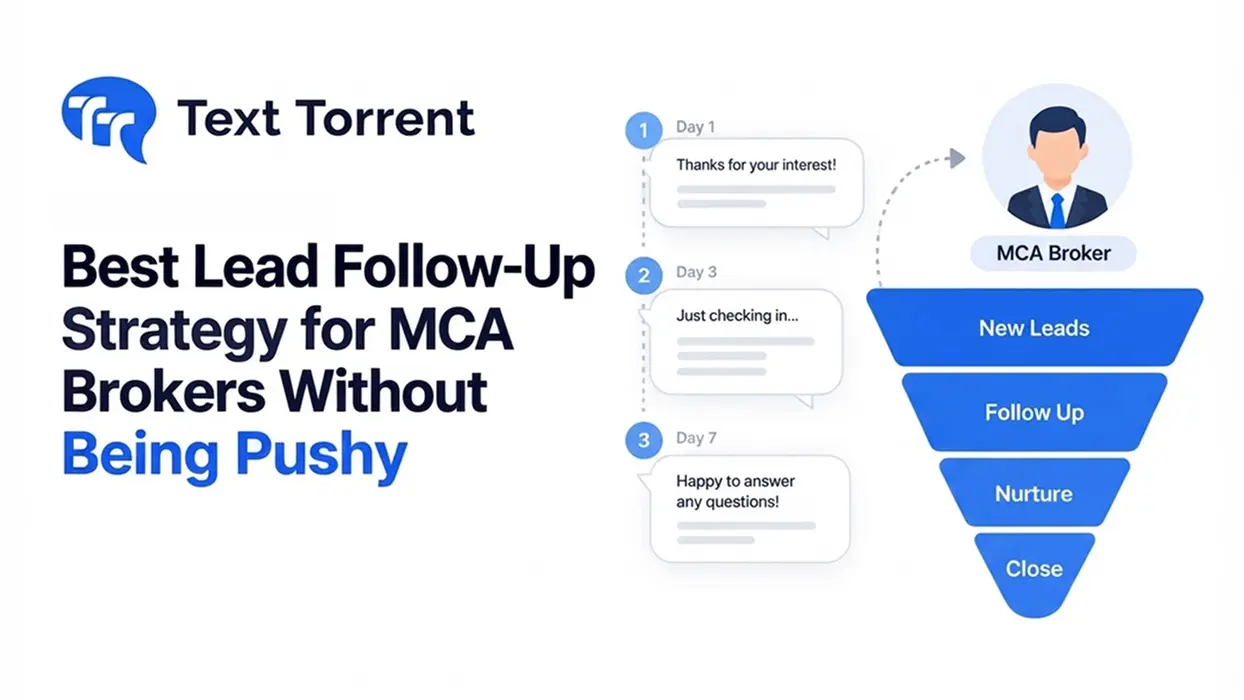
Lead-driven businesses face a different problem. Speed matters, but repeatedly contacting every lead regardless of response can quickly create poor campaign behavior. For example, merchant cash advance SMS workflows need to balance fast lead follow-up with audience quality, consent, reply handling, suppression, and appropriate follow-up decisions.
The requirements change again when communications involve appointments, patient information, reminders, or other sensitive workflows. Businesses evaluating SMS for healthcare communication need to consider the nature of the information being sent and the compliance requirements that apply to their specific organization and use case.
Real estate teams have another operational pattern: new leads, property inquiries, appointment coordination, buyer and seller follow-up, and ongoing conversations can all happen at different stages. A structured real estate SMS workflow can help keep those interactions organized without treating every contact as part of the same campaign.
The real power of SMS in 2026 is therefore not simply sending thousands of texts quickly. It is building a messaging operation where the right audience receives the right message, through an appropriate messaging path, with a clear way to respond or opt out.
SMS has an operational advantage that is difficult to ignore: the message arrives inside a communication channel people already use throughout the day.
There is no separate application the recipient needs to install and no new account they need to create. That makes SMS useful when the communication itself is short, relevant, and connected to an action the recipient already understands.
But visibility should not be confused with results.
An opened message can still be irrelevant, unwanted, mistimed, or incapable of generating action. Businesses should therefore evaluate SMS around the workflow it supports rather than treating message volume as the primary measure of success.
The more useful question is:
What can SMS do operationally that other channels struggle to do as quickly?
It can shorten the distance between a business event and a customer response.
A new lead submits a form. The business can acknowledge the inquiry while it is still relevant.
An applicant needs to provide a document. A short message can tell them exactly what is missing.
An appointment is approaching. A reminder can reduce the chance that the customer simply forgets.
A customer asks for more information. The conversation can continue without forcing them through another communication channel.
These situations appear across very different industries. An insurance company, for example, may need to communicate updates, reminders, or next steps to customers at specific points in its workflow. A structured approach to SMS messaging for insurance businesses can help keep those communications connected to the appropriate customer journey.
Mortgage teams face similar timing pressure but operate around a different process involving inquiries, applications, documentation, appointments, and borrower follow-up. Using business texting for mortgage brokers can help shorten the gap between a required action and the communication that prompts it.
That is where SMS becomes valuable.
Many teams think of SMS marketing as:
List → Message → Send
That model is incomplete.
A mature SMS workflow looks more like:
Consent → Audience → Message → Delivery → Reply → Follow-up → Suppression → Analysis
Each stage affects the next one. Before creating a campaign, teams need to know who should receive it, whether the contact still belongs in the audience, and whether previous activity changes what should happen next. Centralized SMS contact management helps keep those audience decisions connected to the actual messaging workflow.
The send button is only one step.
A campaign can technically send successfully while still failing operationally. If nobody monitors replies, interested contacts wait. If failed messages are ignored, list problems remain hidden. If opt-outs are not synchronized, suppressed contacts can eventually reappear in future campaigns.
The same problem occurs with follow-up. Sending another message to every non-responder is easy, but it does not account for what happened during the first campaign. Using campaign activity to support SMS retargeting creates a more controlled approach where follow-up audiences can be based on relevant recipient behavior.
SMS works best as a controlled communication loop, not a broadcasting shortcut.
One of the most common SMS mistakes is assuming that because a platform accepted a message, the recipient received it.
There are multiple stages between campaign creation and the recipient's phone. Operators therefore need visibility into message outcomes instead of evaluating a campaign solely by the number of messages submitted. Reviewing campaign performance through SMS campaign analytics helps distinguish between messaging states such as Sent, Accepted, Delivered, Failed, or Undelivered where those results are available.
Those distinctions matter.
Sent means the platform processed or submitted the message.
Accepted means the downstream messaging system accepted it for further processing.
Delivered means a delivery confirmation was returned where available.
Failed or Undelivered means the message did not receive a successful delivery outcome.
Even “Delivered” should not be interpreted as “read” or “interested.”
Why SMS delivery problems happen
Delivery can be affected by invalid or unsupported numbers, number configuration, carrier filtering, provider responses, messaging patterns, registration problems, content, use-case mismatches, and poor list quality.
This is why scaling volume without monitoring results is risky. A campaign should establish stable sending behavior before a team significantly increases its audience or frequency.
If delivery quality starts deteriorating, doubling the next campaign does not fix the underlying problem.
Investigate first.
Businesses using US local 10-digit numbers for application-to-person messaging generally need to account for A2P 10DLC registration.
Registration helps identify the business, its messaging use case, and how consumers provide consent. Businesses preparing their messaging infrastructure can use TextTorrent's A2P 10DLC registration support to organize the required business information, messaging use cases, sample messages, consent details, and number onboarding process.
But registration is frequently misunderstood.
10DLC approval is not permission to message anyone.
It does not replace consent. It does not make unrelated campaign content appropriate. It does not guarantee delivery, and it does not override an opt-out.
The practical rule is simple: production messaging should continue to match the business, use case, consent flow, and message purpose represented by the registered campaign.
A database containing 100,000 phone numbers is not automatically a valuable SMS audience.
The operational questions are more important.
Do these contacts belong in this campaign? Do you have the appropriate consent? Are the numbers still valid? Has anyone opted out? Are duplicate records causing repeated communication?
These questions should be answered before campaign creation rather than after problems appear. Keeping lists, subscriber information, and campaign audiences organized through SMS contact management gives operators a clearer foundation for deciding who should actually receive a message.
Audience requirements also depend on the campaign itself. A retail promotion, for example, should not automatically go to every customer who has ever appeared in the database.
An e-commerce business might instead separate recent customers, relevant subscribers, and other appropriate audiences before creating its campaign. This makes SMS marketing for e-commerce more useful as part of a customer lifecycle rather than treating the entire database as one permanent marketing list.
Restaurants have another audience structure involving promotions, customer updates, events, reservation-related communication, and recurring customers. A more controlled approach to SMS marketing for restaurants allows those communications to remain relevant to the people receiving them.
A practical pre-send check should cover:
Confirm the campaign purpose.
Select only the relevant audience.
Verify consent for the intended communication.
Exclude suppressed contacts.
Review invalid or unsupported numbers.
Check obvious duplicates.
Confirm the message matches the expected use case.
Review the final audience before sending.
Smaller, relevant audiences are often operationally better than broadcasting every campaign to the entire database.
A recipient replying to a marketing message is often more important than the original send.
Suppose 10,000 messages go out and 250 people reply.
The campaign is no longer primarily a bulk-send operation. It has created 250 conversations requiring handling, qualification, support, scheduling, or follow-up.
That means teams should plan the reply workflow before launching the campaign.
Who monitors responses? Who owns each conversation? How quickly should interested contacts receive a response? What happens when someone asks to stop? Where does conversation history live?
Instead of moving those replies to employees' personal phones or disconnected systems, businesses can manage them through two-way text messaging, keeping incoming and outgoing communication connected to the business messaging workflow.
The challenge increases when multiple employees handle the same audience. Without visibility, two people can answer the same customer or assume somebody else has already responded. A centralized shared SMS inbox gives teams a common place to manage those conversations and reduce fragmented reply handling.
This is one reason SMS becomes more useful when campaign tools and conversation tools operate together.
Timing Can Make a Good Message Useless
SMS is immediate, which makes poor timing especially noticeable.
An appointment reminder arriving after the appointment has little value. An event update arriving after attendees have already traveled to the venue creates confusion. A follow-up sent long after a lead requested information loses context.
Preparing every campaign manually at the last minute introduces another problem: operators are more likely to rush through audience selection, copy review, and sending-number checks. Preparing campaigns in advance with SMS scheduling gives teams time to review those details before choosing the appropriate future send time.
Timing becomes particularly important for conferences, webinars, appointments, venue changes, registration reminders, and other communications tied to a specific date. Businesses running these programs can incorporate SMS marketing for events into the broader attendee communication workflow rather than relying on last-minute announcements.
Scheduling should not mean “set it and forget it,” however.
Before a scheduled campaign executes, subscriber status and campaign assumptions should still be valid.
Automation becomes useful when a message should happen because something changed.
A contact was created. An opportunity moved to another stage. A lead needs a follow-up. A task was created. A contact was assigned a tag.
These are operational triggers rather than arbitrary calendar dates.
Instead of creating isolated automated messages, teams can use an SMS automation platform to connect supported triggers with actions such as sending an SMS, adding a delay, updating a tag, creating a task, applying supported conditions, or handing the workflow back to a team member.
A simple workflow might look like:
Contact Created → Send acknowledgment → Wait → Create follow-up task → Team follow-up → End
The mistake is assuming that automation means every interaction should remain automated.
Questions, objections, unusual circumstances, and sensitive conversations often require human judgment.
Use automation to remove repetitive work, not human responsibility.
When multiple employees repeatedly write reminders, status messages, and follow-ups from scratch, inconsistencies appear quickly.
One person includes the business name. Another forgets it. One includes the correct opt-out language. Another copies an old promotion. One employee sends an updated link while another continues using an outdated one.
Maintaining reviewed SMS message templates for recurring scenarios can reduce these inconsistencies while still allowing employees to adapt the final message when the situation requires it.
Templates are especially useful for lead acknowledgments, appointment reminders, document requests, status updates, event reminders, common customer questions, and routine follow-up messages.
But templates should still be reviewed before use.
A saved message can become outdated. Dates change. Offers expire. Links move. Policies change. Campaign purposes change.
A template reduces rewriting; it does not remove responsibility for reviewing the final message.
Follow-Up Should Depend on What Happened
One of the easiest ways to damage an SMS program is treating every recipient the same after the first campaign.
A person who replied is different from someone who did not reply. Someone who opted out is different from both. A failed destination is not the same as a non-responder.
And silence does not prove that somebody read the message.
Instead of automatically sending the same second message to everyone, teams can use campaign activity to create more appropriate follow-up groups. TextTorrent's SMS retargeting can support audiences based on campaign activity such as replied and non-replied contacts while keeping current subscriber status in context.
A useful decision rule is:
Replied: continue the relevant conversation.
No reply: consider one relevant follow-up when appropriate.
Failed: investigate before retrying.
Opted out: stop promotional messaging.
This prevents automation from becoming an endless sequence of unwanted reminders.
An unsubscribe request should not depend on someone remembering to remove a row from a spreadsheet.
Suppression needs to become part of the messaging infrastructure so that future campaigns do not accidentally reactivate contacts who should no longer receive promotional messages. Centralized opt-out and blacklist management helps connect supported opt-out handling, blocked-list records, subscriber status, campaigns, and contact management.
This becomes especially important when lists are repeatedly imported.
A new CSV does not create new consent.
A previously suppressed phone number should not become eligible simply because it appears in another spreadsheet.
The same principle applies when teams operate multiple workflows or connected systems: suppression needs to follow the contact.
Teams and Agencies Need Account Separation
SMS operations become more complicated when several teams, departments, branches, or clients share the same platform.
Contacts can end up in the wrong workflow. Employees may access information they do not need. Campaign ownership becomes unclear. Reporting becomes harder to interpret.
Separating these operations with SMS sub-accounts can help businesses organize messaging across clients, teams, branches, departments, or business units without forcing every workflow into the same workspace.
This is especially relevant for marketing agencies that need to keep each client's contacts, campaigns, conversations, and team access organized separately.
Account structure should be planned before volume grows—not after several teams are already sharing one unstructured workspace.
Not every SMS workflow should start manually from a dashboard.
A CRM may create a contact. An internal system may change an opportunity stage. A business application may need to initiate a supported messaging action.
When SMS becomes part of these larger systems, an SMS API and webhooks layer can connect supported messaging operations with the business applications already responsible for contacts, events, or workflow changes.
But integration introduces another responsibility.
Teams need to understand what triggers the message.
A technically successful API request does not automatically mean the resulting message was appropriate.
The same rules still apply: audience relevance, consent, registration alignment, suppression, message content, and monitoring.
Common SMS Marketing Mistakes in 2026
Most campaign failures are not caused by one dramatic technical problem. They are usually a collection of smaller operational mistakes:
Sending to every available contact instead of the relevant audience
Treating 10DLC registration as proof of recipient consent
Assuming Sent means Delivered
Assuming Delivered means Read
Repeatedly messaging non-responders
Ignoring failed-number patterns
Re-importing previously suppressed contacts
Sending content outside the expected messaging use case
Scaling volume before establishing stable campaign performance
Launching campaigns without a plan for handling replies
Automating workflows without clear stopping conditions
Allowing outdated templates to remain active
Each mistake breaks a different part of the messaging loop.
How to Build a Stronger SMS Marketing Workflow
A sustainable SMS program does not start with maximum volume.
Start with control.
First, define exactly why the audience should receive the message. Confirm the appropriate consent and registration path. Organize contacts and suppression records. Create concise copy that identifies the business and gives the recipient a clear next action.
Then test the workflow at manageable volume.
After sending, review campaign analytics for delivery activity, failures, replies, and opt-outs. Investigate abnormal results instead of immediately increasing volume.
When recipients respond, move them into two-way conversations. When they do not respond, follow up selectively rather than automatically creating an unlimited sequence.
When repetitive business events require messaging, automate the appropriate steps while preserving human handoff.
And when messaging becomes part of a larger CRM or business process, use APIs and webhooks without bypassing the controls that apply to manually created campaigns.
The goal is not simply to automate more messages.
The goal is to automate the correct operational decisions around those messages.
The Power of SMS Marketing in 2026 Comes From Control
SMS remains powerful because it is immediate, familiar, conversational, and closely connected to the recipient's phone.
Those strengths also create responsibility.
The businesses that build durable SMS programs will not be the ones that simply find ways to send more messages. They will be the ones that maintain better audiences, clearer consent, appropriate registration, relevant messaging, accurate suppression records, disciplined follow-up, and better visibility into what happened after each send.
Different industries will implement those principles differently, but the underlying operational discipline remains the same. Teams can explore the complete TextTorrent messaging features to see how campaigns, contacts, scheduling, automation, conversations, templates, analytics, retargeting, suppression controls, team management, and API-based messaging fit together.
That is the practical power of SMS marketing in 2026.
It is not just reach.
It is the ability to move from a business event to a relevant message, from that message to a customer response, and from that response to the correct next action—without losing control of the workflow.