- August 21,2026
- 1 month ago
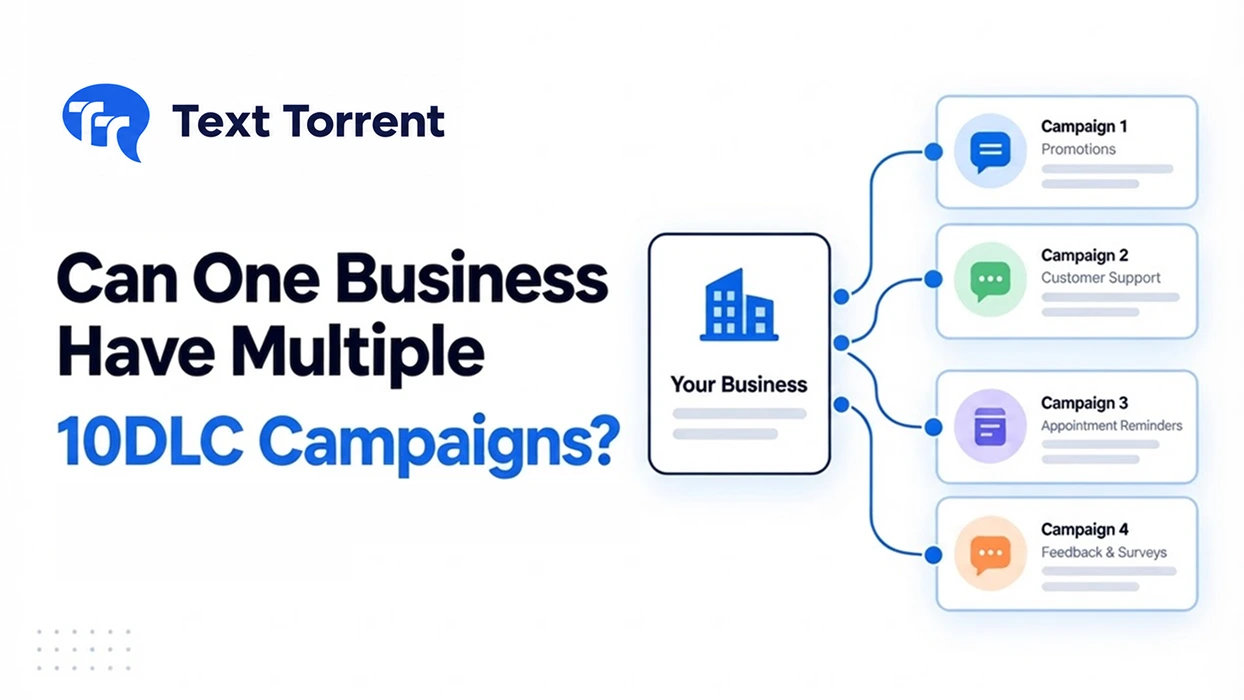
Yes — a single business can run multiple 10DLC campaigns.
But the real question is not “can you.” It’s when you should — and more importantly, how to structure them without creating approval or deliverability problems.
Most teams either:
Try to fit everything into one campaign (which leads to rejection), or
Create too many overlapping campaigns (which leads to confusion and risk signals)
This guide explains how carriers evaluate multiple campaigns under one brand, what breaks when you structure them incorrectly, and how to design a campaign architecture that scales.
In 10DLC, the structure is:
Brand = your verified business identity
Campaign = a specific messaging use case
A single brand can support multiple campaigns — but each campaign must represent a distinct, clearly defined messaging purpose.
Carriers evaluate campaigns individually, but they also monitor behavior across the brand.
What this means in practice
Campaign approvals are independent
Traffic behavior affects your brand-level reputation
Poor performance in one campaign can impact others
Operational reality:
Multiple campaigns increase flexibility — but also increase complexity and risk if not structured properly.
You should create multiple campaigns only when your messaging use cases are functionally different.
Valid reasons for multiple campaigns
Transactional vs marketing messaging
Different user journeys (e.g., onboarding vs retention)
Different products or services with separate communication flows
Distinct consent models
Example structure
Campaign 1: Appointment reminders (transactional)
Campaign 2: Promotional offers (marketing)
Campaign 3: Account alerts (informational)
What breaks if you don’t separate them
Rejection due to “overbroad use case”
Content mismatch during review
Filtering when traffic types mix
Decision rule:
If messages have different purposes, triggers, or consent expectations, they should be separate campaigns.
Creating multiple campaigns without clear boundaries introduces risk.
Common mistakes
Splitting one use case across multiple campaigns
Creating campaigns with overlapping definitions
Using multiple campaigns to bypass throughput limits
What breaks
Rejections for redundancy or duplication
Confusion during review
Brand-level trust degradation
Why it happens
Carriers evaluate whether your campaign structure reflects real business behavior. Artificial segmentation looks like an attempt to manipulate the system.
Decision rule:
If two campaigns look similar enough to be merged, they probably should be.
As the number of campaigns increases, so does the need for precision.
Each campaign has a distinct purpose
No overlap in message type
Clear mapping between use case and message content
Writing vague descriptions across campaigns
Reusing the same language for multiple campaigns
Not clearly defining boundaries
Rejections for unclear differentiation
Increased manual review
Delays in approval
Each campaign should answer:
Who is receiving messages?
What triggers the message?
What type of content is sent?
Decision rule:
If you cannot explain how two campaigns are different in one sentence, they are not distinct enough.
Consent is not shared automatically across campaigns.
Each campaign must align with its own consent expectation.
Common mistakes
Using one opt-in flow for multiple campaign types
Sending marketing messages under transactional consent
Not differentiating user expectations
What breaks
Compliance issues
Increased opt-outs and complaints
Filtering or enforcement actions
How to do it right
Ensure:
Transactional campaigns are tied to user actions
Marketing campaigns have explicit promotional consent
Opt-in language reflects the campaign type
Decision rule:
If a user didn’t explicitly agree to that type of message, it should not be in that campaign.
Each campaign submission includes message samples — and those samples must reflect only that campaign.
Common mistakes
Using similar or identical samples across campaigns
Mixing transactional and promotional tone
Writing generic samples that could apply anywhere
What breaks
Content mismatch rejection
Confusion during review
Increased filtering risk
How to do it right
Keep samples tightly aligned with the use case
Avoid overlapping language between campaigns
Reflect real message behavior
Decision rule:
If a sample could belong to another campaign, it’s too generic.
Even though campaigns are approved individually, carriers monitor aggregate behavior at the brand level.
What this means
High complaint rates in one campaign can affect others
Traffic spikes across campaigns can trigger filtering
Reputation is shared
Common mistakes
Treating campaigns as isolated systems
Scaling one campaign aggressively while others are stable
Ignoring cross-campaign patterns
What breaks
Reduced throughput across campaigns
Increased filtering
Brand-level scrutiny
How to do it right
Monitor performance across all campaigns
Keep traffic patterns controlled and predictable
Maintain consistent quality across message types
Decision rule:
If one campaign behaves poorly, assume it will impact your entire messaging operation.
Before creating multiple campaigns, validate:
Separation
Each campaign has a distinct purpose
No overlap in message type or trigger
Use Case
Clearly defined and specific
Easily distinguishable from other campaigns
Consent
Matches the campaign type
Not reused across incompatible use cases
Message Samples
Unique per campaign
Reflect real usage
No duplication
Traffic Strategy
Predictable scaling
No artificial segmentation
Monitored across campaigns
Yes, one business can have multiple 10DLC campaigns — and in many cases, it should.
But multiple campaigns are not a scaling shortcut. They are a structural decision.
Carriers expect:
Clear separation of use cases
Consistent consent models
Predictable messaging behavior
If your campaign structure reflects how your business actually communicates, approvals are straightforward and performance is stable.
If it doesn’t, the system compensates — through rejection, filtering, or reduced throughput.
Treat campaign structure as part of your messaging architecture, not just a submission requirement. That’s what allows multiple campaigns to scale without breaking.