- August 21,2026
- 1 month ago
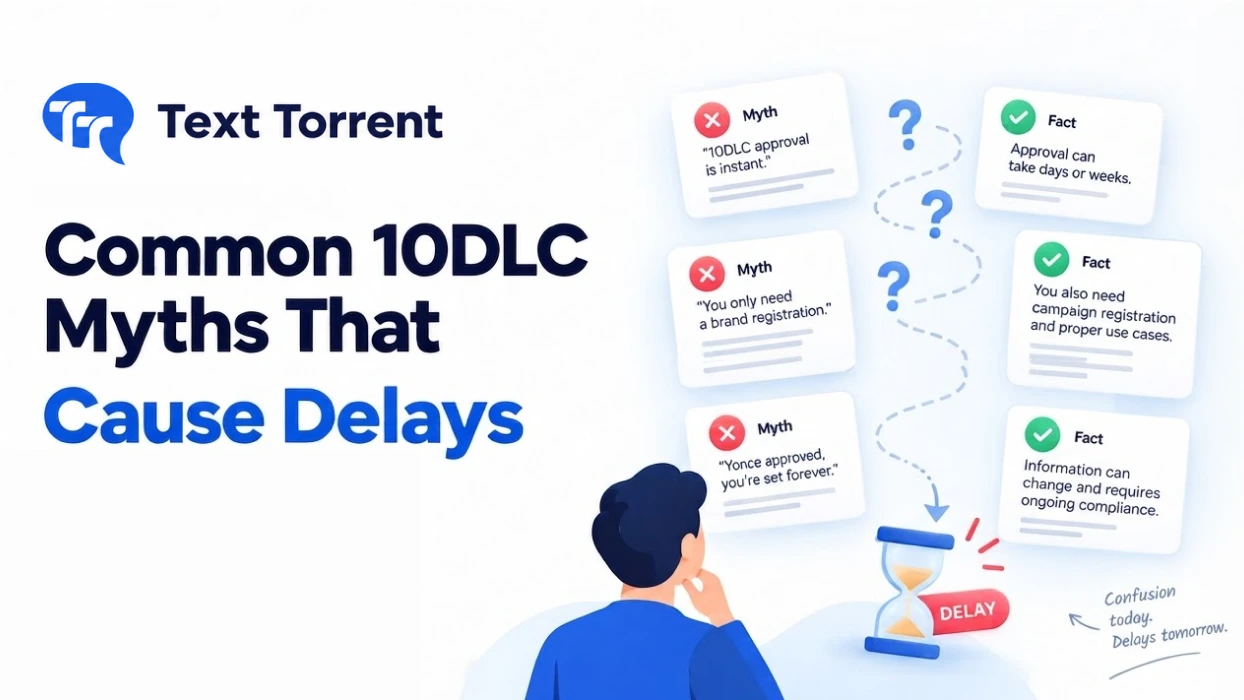
Most 10DLC delays aren’t caused by carriers being slow. They’re caused by incorrect assumptions during registration.
Teams often approach 10DLC like a simple compliance form. In reality, it’s a verification system that checks whether your business, messaging
behavior, and consent flow all align.
The gap between what teams think matters and what carriers actually validate is where delays happen.
This guide breaks down the most common 10DLC myths that slow down approval—and what to do instead.
What teams assume
If the business name is mostly correct, approval should go through.
What actually happens
Carriers validate your brand against official records:
EIN
Legal entity name
Business registration data
Even small mismatches—spacing, abbreviations, entity type—can trigger verification failure.
What breaks if ignored
Brand marked as unverified
Campaign submission blocked
Repeated resubmissions required
How to do it right
Use the exact legal name tied to your EIN
Match formatting precisely (LLC vs INC matters)
Verify your business is publicly identifiable online
What teams assume
Descriptions like “customer engagement” or “notifications” are acceptable.
What actually happens
Carriers assign risk based on clarity. Vague use cases increase uncertainty, which increases risk.
They expect:
Specific message type
Defined audience
Clear purpose
What breaks if ignored
Campaign rejection
Lower trust score even if approved
Increased scrutiny during review
How to do it right
Instead of:
“We send updates to customers”
Use:
“We send appointment reminders to customers who booked services via our website”
Clarity reduces perceived risk.
What teams assume
A single campaign can handle:
Promotions
Alerts
Customer support
What actually happens
Each use case has a different risk profile:
Promotional traffic → higher scrutiny
Transactional traffic → lower risk
Support messages → conversational
Combining them creates inconsistent behavior.
What breaks if ignored
Approval delays
Lower throughput assignment
Filtering after approval
How to do it right
Separate campaigns by use case
Keep each campaign behavior predictable
Align message examples with each campaign type
What teams assume
Examples are just placeholders to complete the form.
What actually happens
Message examples are one of the primary validation tools carriers use to:
Understand tone
Verify use case alignment
Assess compliance
What breaks if ignored
Delays due to unclear messaging intent
Requests for clarification
Increased manual review time
How to do it right
Use real, production-like messages
Include sender identification
Include opt-out language
Example:
“Hi John, this is ABC Dental. Your appointment is tomorrow at 2 PM. Reply STOP to opt out.”
What teams assume
If users interact with the business, consent is implied.
What actually happens
Carriers require explicit, documented consent:
Clear opt-in action
Transparent disclosure
Verifiable record
Implicit consent is treated as high risk.
What breaks if ignored
Campaign rejection
Increased compliance scrutiny
Future delivery issues even after approval
How to do it right
Show exactly how users opt in
Include full disclosure language
Store consent records (timestamp, source)
What teams assume
Registration data alone is enough.
What actually happens
Carriers validate your business through your website:
Does it exist?
Does it match your claimed identity?
Does it support your messaging use case?
What breaks if ignored
Brand verification failure
Campaign rejection due to lack of legitimacy
How to do it right
Ensure your website clearly describes your business
Include a visible privacy policy
Align site content with your messaging use case
What teams assume
Once approved, messaging behavior doesn’t matter.
What actually happens
Approval sets a baseline. Carriers continuously monitor:
Message content
Engagement rates
Opt-out patterns
Traffic behavior
What breaks if ignored
Gradual filtering increase
Trust score degradation
Campaign suspension
How to do it right
Keep messaging aligned with your registered use case
Monitor engagement signals
Adjust behavior before issues escalate
What teams assume
Submitting quickly gets you approved faster.
What actually happens
Incomplete or incorrect submissions:
Enter review queues
Get flagged
Require resubmission
This extends timelines significantly.
What breaks if ignored
Multiple rejection cycles
Delays of days or weeks
Operational bottlenecks
How to do it right
Validate everything before submitting
Treat registration as a one-time correct process
Avoid rushing incomplete data
Before submitting, confirm:
Identity
EIN and legal name match exactly
Business is verifiable online
Use Case
Specific, single-purpose description
Matches actual messaging behavior
Message Examples
Realistic and compliant
Include opt-out language
Consent
Explicit opt-in process documented
Full disclosure included
Website
Reflects business and messaging intent
Includes privacy policy
Campaign Structure
One use case per campaign
No mixing of message types
If any field feels “generic” → rewrite it
If your website doesn’t clearly support your use case → fix it first
If your opt-in isn’t provable → strengthen it before submitting
If you’re combining use cases → split them into separate campaigns
Delays almost always trace back to one of these.
Most platforms allow you to submit and wait.
TextTorrent focuses on reducing failure before submission.
That includes:
Verifying business identity against carrier expectations
Structuring campaigns based on real messaging behavior
Reviewing use cases for clarity and risk alignment
Identifying gaps in consent and website validation
Instead of relying on trial-and-error submissions, issues are corrected upfront—reducing approval cycles and delays.
10DLC delays are rarely caused by complex rules. They’re caused by incorrect assumptions.
Most teams:
Use vague descriptions
Skip validation steps
Treat registration as a formality
Carriers treat it as a risk assessment.
If your submission clearly answers:
Who you are
What you send
Why users receive it
Approval is straightforward.
If it doesn’t, delays are expected.