- August 21,2026
- 1 month ago
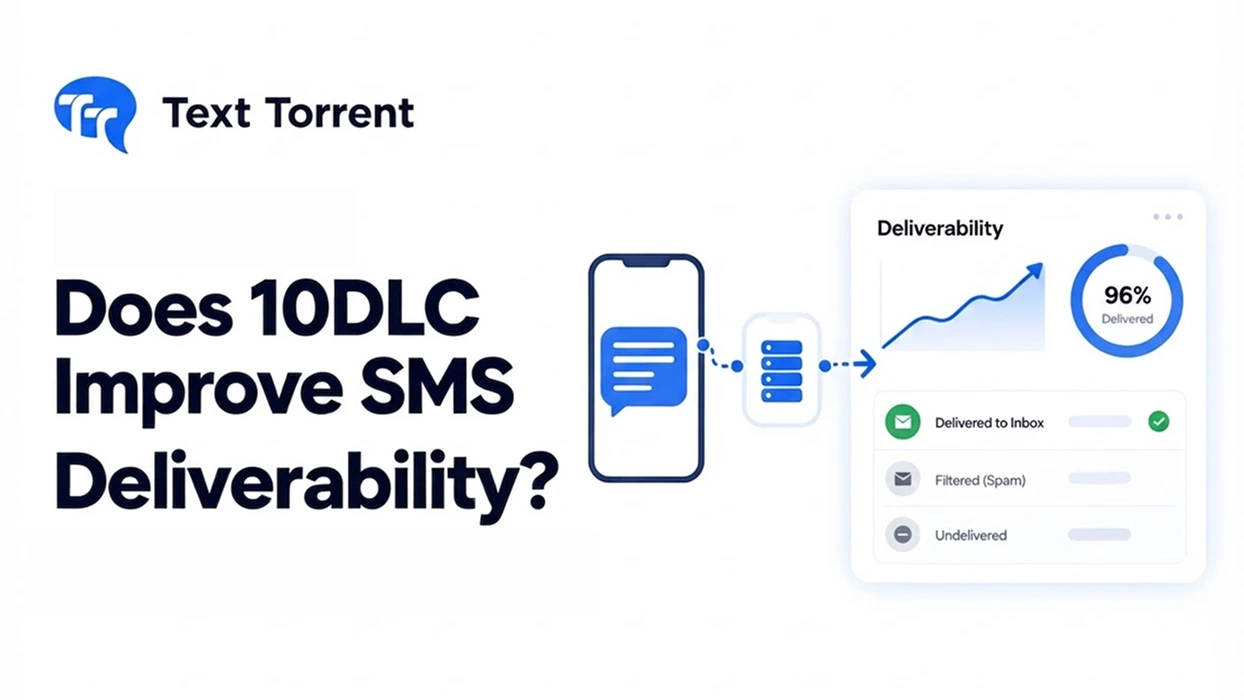
yes—but only if everything behind it is done correctly.
10DLC (Application-to-Person messaging over local numbers) does not “boost delivery” on its own. It establishes identity, assigns trust, and defines how carriers should treat your traffic. Deliverability improves only when your messaging behavior aligns with what you registered.
Many teams assume approval equals inbox placement. In practice, approval is just the starting condition for stable delivery.
This guide explains how 10DLC actually affects deliverability, what it fixes, what it doesn’t, and how to use it correctly at scale.
Before 10DLC, most A2P traffic looked anonymous:
No verified business identity
No declared use case
No predictable traffic profile
Carriers responded by filtering aggressively.
10DLC changes that by attaching three key signals to your traffic:
Verified brand identity (who is sending)
Declared campaign use case (what is being sent)
Assigned trust score and throughput (how much and how fast you can send)
These signals don’t guarantee delivery—but they determine how your traffic is evaluated.
1. It Establishes Trust With Carriers
Approved campaigns receive a trust score based on:
Business legitimacy
Risk category
Use case clarity
This score directly impacts:
Filtering sensitivity
Throughput limits
Long-term delivery stability
What improves:
Messages are less likely to be treated as unknown traffic
Filtering becomes behavior-based instead of default
What breaks if ignored:
If your messaging behavior deviates, trust degrades—even after approval.
2. It Enables Predictable Throughput
Without 10DLC:
Messages are throttled unpredictably
Volume scaling triggers filtering
With 10DLC:
You get defined throughput limits
Traffic is expected within those limits
What improves:
Campaign timing becomes reliable
Large sends can be executed without random delays
Common mistake:
Teams exceed assigned throughput and assume delivery will hold.
Result:
Carriers throttle or filter traffic despite approval.
3. It Aligns Content With Intent
10DLC forces you to define:
What messages you send
Why users receive them
How consent is collected
Carriers continuously compare your live traffic against that definition.
What improves:
Consistent, aligned messaging builds long-term trust
Lower filtering when behavior matches registration
What breaks if ignored:
If you send outside your declared use case:
Filtering increases
Trust score drops
Campaign risk rises
4. It Reduces False Positives in Filtering
Unregistered traffic is often flagged based on patterns alone.
10DLC provides context:
Who the sender is
What the traffic represents
What improves:
Legitimate campaigns are less likely to be misclassified
Messages have a clearer path to the inbox
Important nuance:
This does not override poor behavior. It only reduces unnecessary filtering for compliant traffic.
This is where most teams get it wrong.
10DLC does not solve:
1. Poor List Quality
If your recipients:
Didn’t clearly opt in
Don’t recognize your brand
You will see:
Low engagement
High opt-outs
Increased filtering over time
2. Weak Message Content
Even approved campaigns get filtered when:
Messages are repetitive
Tone is overly promotional
Content reduces replies
Carriers measure outcomes, not intent.
3. Bad Traffic Patterns
If your sending behavior includes:
Sudden volume spikes
Perfectly uniform timing
High burst velocity
You trigger detection systems regardless of approval status.
4. Link Risk and Domain Issues
Links are heavily evaluated.
10DLC does not protect you from:
Low-reputation domains
Frequent link changes
Public shortener overuse
“Approval guarantees inbox delivery”
It doesn’t. It only qualifies your traffic to be evaluated fairly.
“Once approved, we can send anything”
Mismatch between registration and actual messaging is one of the fastest ways to lose trust.
“Throughput equals performance”
High throughput allows sending more messages—not better delivery.
“We can fix delivery later”
Most delivery issues start at registration and compound after approval.
Registration Accuracy
Does your business name exactly match EIN records?
Is your use case specific and realistic?
Message Alignment
Do your live messages match your declared campaign purpose?
Are you avoiding mixing use cases?
Traffic Control
Are you sending within assigned throughput limits?
Is volume distributed instead of burst-based?
Engagement Monitoring
Are reply rates stable across campaigns?
Are opt-outs within expected range?
Link Consistency
Are you using the same domain across campaigns?
Is your link structure predictable?
If delivery drops after approval → check behavior, not registration first
If filtering increases → review use case alignment and content patterns
If scaling fails → adjust traffic distribution before adding volume
If trust degrades → reduce risk signals (opt-outs, repetition, link changes)
10DLC creates the framework. Behavior determines the outcome.
Most platforms treat 10DLC as a compliance step.
TextTorrent treats it as part of delivery control.
Before and after approval, the system ensures:
Campaign structure matches real-world messaging
Traffic distribution aligns with throughput limits
Content patterns don’t trigger unnecessary filtering
Engagement signals are monitored continuously
Instead of relying on approval alone, delivery is maintained by controlling the signals carriers evaluate every day.
Final Takeaway
Yes, 10DLC improves SMS deliverability—but only indirectly.
It gives you:
Identity
Trust baseline
Defined throughput
It does not guarantee:
Inbox placement
High engagement
Filtering immunity
Those come from how you operate within the system.
If you treat 10DLC as a checkbox, delivery will still fail.
If you treat it as the foundation of how your traffic is evaluated, deliverability becomes predictable—and scalable.