
- August 21,2026
- 1 month ago
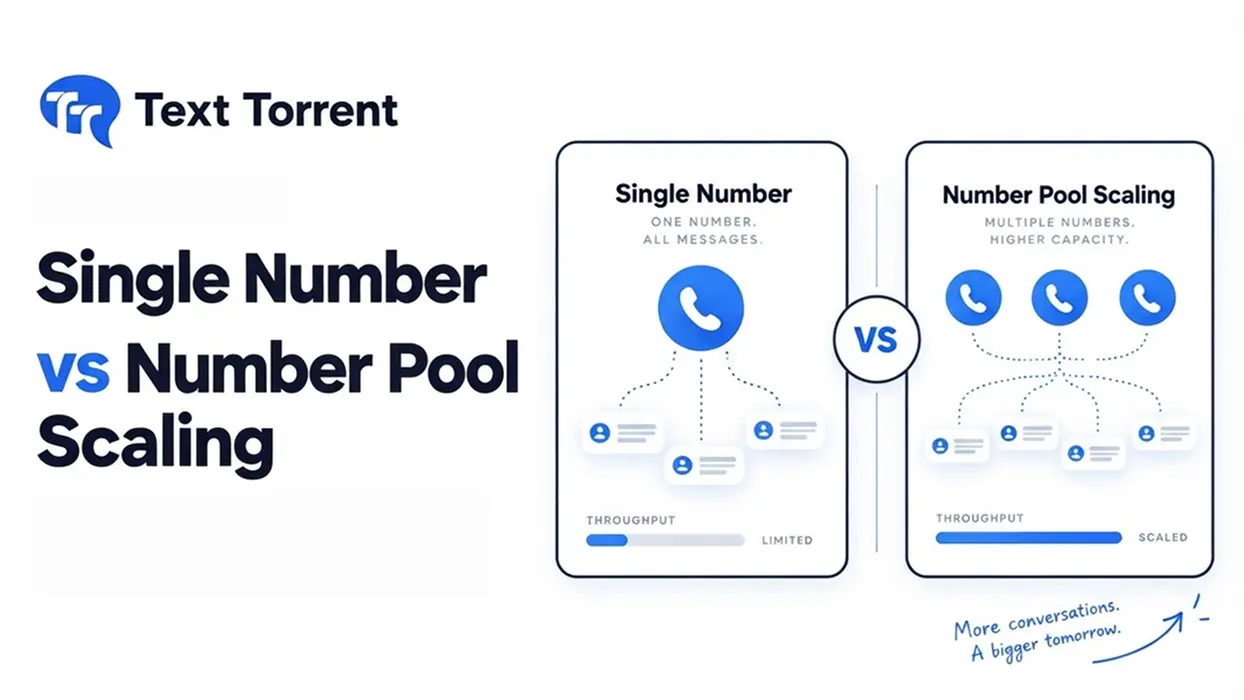
As SMS programs grow, businesses eventually face an important operational decision:
Should campaigns continue using a single sending number, or should traffic be distributed across a number pool?
At first glance, the answer appears obvious. More numbers should mean more capacity.
In reality, the decision is more complicated.
Many businesses move to number pools too early and create unnecessary complexity. Others continue relying on a single number long after traffic volume has outgrown it, resulting in delivery issues, throughput bottlenecks, filtering concerns, and declining campaign performance.
The challenge is that scaling SMS is not simply about sending more messages. It is about maintaining deliverability, compliance, reputation, and customer experience while increasing volume.
Understanding the differences between single-number and number-pool scaling helps businesses make better decisions as messaging programs grow.
Single number scaling refers to sending all campaign traffic through one phone number.
Every outbound message originates from the same source.
Replies return to the same inbox.
Customer conversations remain tied to a single identity.
For smaller messaging programs, this approach offers significant advantages.
Benefits of a Single Number
A single number creates consistency.
Recipients repeatedly see the same sender.
Over time, this familiarity can improve engagement and trust.
Other benefits include:
Simpler conversation management
Easier reporting
Stronger customer recognition
Less operational complexity
Centralized message history
For businesses sending relatively low or moderate volumes, a single number often provides the cleanest experience.
Problems emerge when traffic volume grows faster than a single number can comfortably support.
As message volume increases, several challenges appear.
Throughput Limitations
Every number has practical sending limits.
Attempting to push large campaign volumes through a single number can create bottlenecks.
Messages may take longer to process.
Delivery timing becomes less predictable.
Traffic Concentration
When all traffic originates from one number, all reputation signals accumulate on that number.
This includes:
Complaints
Opt-outs
Engagement patterns
Filtering signals
Positive reputation can be valuable.
Negative reputation can become equally concentrated.
Operational Risk
A problem affecting one number affects the entire messaging program.
There is no traffic distribution mechanism available.
This creates a single point of failure.
Number pool scaling distributes traffic across multiple sending numbers.
Instead of sending all messages through one number, campaigns rotate traffic among several numbers.
For example:
Number A sends part of the campaign
Number B sends another portion
Number C sends another portion
This approach spreads traffic volume across multiple sending identities.
As campaign volume grows, additional numbers can be added to the pool.
The primary reason is capacity.
As subscriber databases expand, message volume grows.
Businesses often reach a point where a single number no longer provides sufficient throughput.
A number pool allows traffic distribution across multiple numbers, making larger campaigns more manageable.
Additional Benefits
Number pools can also help:
Reduce traffic concentration
Improve campaign throughput
Support larger databases
Create operational redundancy
For high-volume programs, these advantages can become significant.
One of the most common misconceptions in SMS scaling is that adding numbers automatically improves delivery performance.
This is not necessarily true.
Carriers do not evaluate numbers in isolation.
They evaluate overall sender behavior.
If a business has:
Poor consent practices
High complaint rates
Weak reputation
Adding more numbers rarely solves the underlying problem.
In some cases, it creates additional complexity while leaving the root issue untouched.
Operational Rule
Number pools improve capacity.
They do not automatically improve trust.
Reputation management changes significantly when multiple numbers are introduced.
Single Number Reputation
With one number:
Reputation develops faster
Customer recognition improves
Historical performance remains centralized
Positive engagement strengthens the same identity repeatedly.
Number Pool Reputation
With multiple numbers:
Reputation becomes distributed
Traffic signals spread across numbers
Number management becomes more important
This can be beneficial when managed properly.
However, reputation must still be earned individually by each number.
Common Mistake
Many businesses add new numbers and immediately assign high traffic volumes.
New numbers possess limited reputation history.
This often creates unnecessary scrutiny.
Customer experience is frequently overlooked during scaling discussions.
Yet it often determines long-term campaign success.
Single Number Experience
Recipients consistently see the same number.
Benefits include:
Familiarity
Trust
Easier conversation continuity
Customers know who is contacting them.
Number Pool Experience
Recipients may receive messages from different numbers over time.
Without proper management, this can create confusion.
For example:
A customer receives a promotion from one number
A reminder from another
A follow-up from a third
The communication may feel fragmented.
Best Practice
If using number pools, maintain consistent branding and conversation management wherever possible.
Scaling introduces additional compliance responsibilities.
Many organizations focus heavily on throughput while overlooking compliance implications.
Single Number Simplicity
One number generally means:
Simpler oversight
Easier documentation
Fewer operational variables
Number Pool Complexity
Additional numbers require:
Consistent configuration
Proper registration
Ongoing monitoring
As pools expand, compliance management becomes more important.
What Breaks If Ignored
Poorly managed number pools can create:
Registration inconsistencies
Monitoring gaps
Reputation problems
Scaling infrastructure must be supported by operational discipline.
A single number often remains the best option when:
Message volume remains moderate
Conversations are highly personal
Customer relationships are ongoing
Throughput requirements remain manageable
Industries commonly benefiting from single-number approaches include:
Professional services
Small healthcare practices
Local businesses
Appointment-based operations
The simplicity often outweighs the benefits of additional numbers.
Number pools become more valuable when:
Databases grow significantly
Campaign volume increases substantially
Throughput requirements expand
Large-scale campaigns become routine
Examples include:
Agencies
Multi-location organizations
High-volume marketing operations
Large customer communication programs
At this stage, operational scalability becomes increasingly important.
How Businesses Usually Get It Wrong
Several mistakes appear repeatedly.
Adding Numbers Too Early
Some organizations create pools before traffic volume requires them.
This introduces complexity without meaningful benefit.
Adding Numbers Too Late
Others continue relying on a single number long after throughput limitations become problematic.
Ignoring Reputation
Additional numbers do not replace reputation management.
Treating Pools as a Deliverability Solution
Number pools support scaling.
They do not automatically solve deliverability issues.
A Practical Decision Framework
Before moving to a number pool, ask:
Is Throughput Becoming a Limitation?
If messages are taking too long to complete, additional capacity may be needed.
Is Traffic Volume Growing Consistently?
Future growth matters as much as current volume.
Monitoring requirements increase with scale.
Is Customer Experience Being Preserved?
Infrastructure decisions should not create subscriber confusion.
Before choosing a scaling strategy, verify:
Reputation
Complaint rates remain low
Delivery rates remain stable
Engagement remains healthy
Compliance
Registrations remain accurate
Consent records are documented
Infrastructure
Throughput requirements are understood
Monitoring systems exist
Reporting is available
Customer Experience
Conversation continuity is maintained
Branding remains consistent
The choice between a single number and a number pool is not simply a technical decision. It is a scaling decision that affects throughput, reputation, compliance, customer experience, and operational complexity.
Single numbers provide simplicity, consistency, and centralized reputation management. Number pools provide additional capacity, traffic distribution, and scalability for larger programs.
The right approach depends on campaign volume, growth plans, operational maturity, and customer communication requirements.
Businesses that scale successfully do not view number pools as a shortcut to better deliverability. Instead, they use them as part of a broader strategy that includes strong consent practices, reputation management, compliance oversight, and thoughtful traffic growth.
Ultimately, the goal is not to send messages through more numbers. The goal is to maintain reliable delivery and a positive customer experience as messaging volume expands over time.