- October 20,2026
- 1 month ago
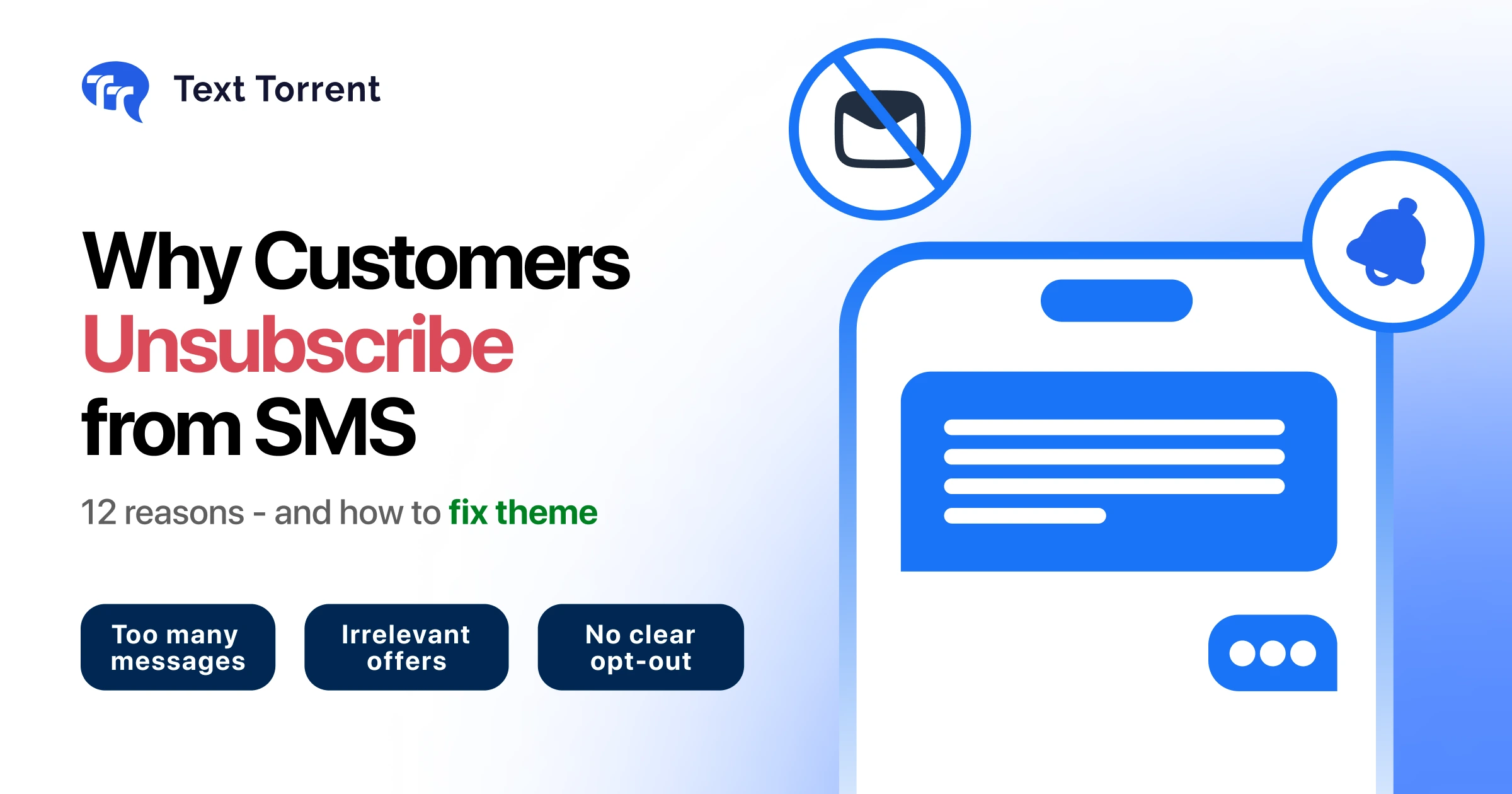
Customers rarely unsubscribe because “SMS does not work.” They unsubscribe because the messages stop feeling useful enough to justify access to a personal channel.
An opt-out is often the visible result of an earlier operating problem: the business sent too often, targeted too broadly, ignored a completed action, used stale data, or kept automation running after a real conversation started.
The goal is not to prevent people from leaving. It is to make leaving easy and learn from the pattern. TextTorrent’s opt-out and blacklist management workflow connects configured STOP handling, blocked-list records, subscriber status, campaign exclusion, imports, and conversation history so suppressed contacts stay out of supported messaging. Its campaign analytics and reporting tools also help teams review replies, delivery-related results, and campaign activity before deciding what to send next.
Unsubscribes are most useful when viewed by campaign, audience, and workflow. A restaurant promotion, real estate property alert, e-commerce offer, and mortgage document reminder serve different needs. They should not share one universal cadence.
Here are the 12 reasons worth investigating first.
Frequency problems are cumulative.
A subscriber may receive a weekly promotion, an automated reminder, a retargeting message, and a manual follow-up. Each sender thinks one text is reasonable. The recipient experiences four interruptions from one business.
What breaks: Teams evaluate campaigns separately instead of counting total contact-level exposure.
How to fix it: Set a contact-level frequency policy. Before another campaign goes out, check what else that person recently received, including automation and human follow-up.
The important number is not simply “campaigns per month.” It is how many messages actually reach the same subscriber across every workflow.
A technically valid audience can still be a poor audience.
A real estate buyer interested in condos should not receive every commercial listing. A restaurant guest tied to one location should not repeatedly receive offers for another city. An e-commerce buyer should not get unrelated promotions simply because their number is on the master list.
TextTorrent’s contact management workspace connects lists, contact status, campaign audiences, suppression visibility, and conversation context, making audience organization part of the sending workflow rather than a separate spreadsheet exercise.
What breaks: Broad sends create short-term reach at the cost of long-term list quality.
How to fix it: Segment around information that changes the message: location, product interest, lifecycle stage, purchase status, property type, service need, or previous campaign response.
If the message would not change when the segment changes, that field probably is not useful.
A customer may join for shipping updates, reservation reminders, property alerts, or a specific offer. Problems begin when that narrow expectation quietly becomes permission for every promotion.
Customers remember what they believed they signed up for.
What breaks: The business optimizes the opt-in form for conversion but disconnects the disclosure from campaign strategy.
How to fix it: Preserve the source and purpose of the signup. Organize contacts into the relevant list, group, or tag instead of immediately merging every subscriber into one promotional audience.
Ask before sending:
Would this message surprise someone who joined through that signup path?
If the answer is yes, review the audience before sending.
Relevance can expire by the hour.
A lunch offer sent after the customer has eaten is noise. An open-house reminder after the event starts is useless. A late-night promotion may feel intrusive even when the offer is good.
This is especially visible in industries where the action window is narrow. Restaurant messaging workflows can involve reservations, events, menu updates, and time-sensitive offers, while real estate messaging workflows can involve property alerts, showings, and open-house reminders.
What breaks: The team chooses to send time based on staff availability rather than when the recipient can act.
How to fix it: Work backward from the action. Restaurant campaigns should consider meal-decision windows. Real estate reminders should leave enough time to travel or schedule. E-commerce promotions should arrive while the offer is still usable.
TextTorrent’s SMS scheduling tools let teams prepare and review campaigns in advance and select a future send window.
Repeated wording trains subscribers to stop paying attention.
“Last chance.”
“Still interested?”
Another discount. Another reminder about the same offer.
What breaks: Retargeting becomes “send the same message again.”
How to fix it: A follow-up should add information, answer a likely objection, change the next step, or stop.
TextTorrent’s campaign retargeting workflow can build follow-up audiences from supported campaign activity such as replied and non-replied contacts. But non-response is not evidence that someone needs unlimited reminders.
One relevant follow-up is better than an automated loop with no new reason to respond.
If every text asks the customer to buy, book, upgrade, claim, or hurry, there is little reason to keep the channel open between purchases.
Useful SMS programs can also provide appointment reminders, reservation updates, order information, status changes, event details, or requested alerts where those messages fit the relationship.
What breaks: SMS becomes advertising inventory instead of a customer communication channel.
How to fix it: Review your last ten sends. How many primarily helped the recipient versus primarily helped the sender?
For example, e-commerce messaging workflows can separate order and delivery communication from promotional campaigns. Restaurants can separate reservation communication from offers.
The mix should follow the customer relationship.
Bad personalization is worse than no personalization.
The wrong first name, an old city, a rejected property type, a product already purchased, or a reminder for a canceled appointment signals that the system does not understand the recipient.
What breaks: Teams treat variables as personalization without checking the data behind them.
How to fix it: Personalize only from fields you trust. Define which attributes expire and when they should be updated.
If a field cannot be confirmed, use neutral copy instead of pretending certainty.
Also separate permanent attributes from temporary state. A customer’s preferred location may remain useful for months. “Needs an appointment” may become incorrect tomorrow.
A lead books the appointment, then receives “Ready to schedule?”
A customer submits a document, then gets another reminder.
A buyer replies to a property alert and later receives a generic non-response follow-up.
The workflow is behind reality.
What breaks: Automation checks whether enough time passed but not whether the underlying state changed.
How to fix it: Revalidate customer state before every automated follow-up. Completion should create an exit condition.
TextTorrent’s SMS automation tools support trigger- and workflow-based messaging actions, while replies can move into conversation handling. TextTorrent also cautions that teams should not assume replies automatically stop or change every workflow unless that behavior has been explicitly configured and verified.
Marketing sends a promotion.
Sales sends a follow-up.
Operations sends a reminder.
An automated sequence also fires.
Each workflow may be legitimate alone. Together, they feel chaotic.
What breaks: No system decides which message has priority.
How to fix it: Establish precedence rules.
Active service communication may outrank promotions. An active human conversation should usually suppress generic automated nudges. Recent conversions should leave acquisition follow-up.
For agencies and multi-team businesses, assign responsibility for audience status instead of letting every team independently message every eligible record.
Campaign collision is usually an ownership problem disguised as a frequency problem.
SMS is strong for concise, timely actions. It becomes frustrating when businesses force complex processes into fragmented texts.
Long explanations, sensitive document exchanges, disputes, detailed policy language, or multi-step support may need another channel or a human conversation.
What breaks: Teams automate a process because texting is available, not because texting is appropriate.
How to fix it: Use SMS to move the customer to the next clear step.
In a mortgage workflow, for example, a text can remind an applicant that a document is missing and direct them to the approved submission process rather than requesting sensitive financial information in an ordinary text conversation.
The text should simplify the next action—not become the entire process.
Two-way messaging creates an expectation: replies should matter.
A customer says:
“I already bought it.”
“Call me next week.”
“Not this property.”
“Can I speak to someone?”
If the next automated message ignores that response, trust falls quickly.
What breaks: Replies are treated as engagement metrics instead of workflow events.
How to fix it: Define who owns replies and which responses should stop or change automation.
TextTorrent’s two-way texting workflow keeps supported replies connected to conversation history so staff can continue with context.
Automation should handle predictable steps. People should handle interpretation, exceptions, questions, and objections.
Trying to reduce churn by making opt-out difficult is the wrong objective.
If someone wants to leave, keeping them on the list creates a worse audience and additional compliance risk.
FCC rules for covered robocalls and robotexts recognize reasonable methods of revoking consent and require applicable revocation requests to be honored within a reasonable period not exceeding ten business days. Operationally, businesses should suppress a clear request as quickly as their systems allow.
TextTorrent lets accounts configure opt-out words, can auto-block contacts when configured words such as STOP are received, supports manual blocking for requests received through other channels, and keeps blocked contacts out of supported campaign workflows while suppressed.
How to fix it: Treat STOP as a workflow event, not a campaign metric.
Create a process for clear requests received through support, phone, email, or another channel. A new contact import should not erase an existing suppression record.
Do not immediately rewrite the copy.
Start with the audience and workflow.
Compare opt-outs by campaign type, list, signup source, send time, lifecycle stage, and recent contact frequency. Then ask:
Did send frequency increase?
Did the audience become broader?
Was a new imported list used?
Did several automations overlap?
Did timing change?
Did the offer differ from the signup promise?
Were completed customers still being retargeted?
Did stale data create personalization errors?
Were replies handled before the next send?
TextTorrent SMS analytics can help teams review campaign results, replies, delivery-related statuses, and individual message activity before deciding on follow-up.
Do not treat Delivered as proof of satisfaction. Standard SMS delivery reporting does not show that a recipient read or liked the message. TextTorrent specifically distinguishes delivery confirmation from message reading.
A Pre-Send Checklist for Reducing Avoidable Opt-Outs
Before launching another campaign, confirm:
The audience has a clear reason to receive it.
The message matches the original signup context.
Contact-level frequency is acceptable.
Timing leaves a realistic action window.
Recent converters and completed actions are excluded.
Active human conversations are not interrupted.
Personalization fields are current.
Non-responders are not trapped in endless follow-up.
Blacklisted and opted-out contacts remain suppressed.
Replies have a clear owner.
The campaign has one useful next action.
You know how you will judge whether the send was worthwhile.
Some SMS unsubscribes are unavoidable. Customers need change. A purchase cycle ends. Someone moves, changes jobs, or simply no longer wants the communication.
The goal is not a zero opt-out rate.
The goal is to eliminate preventable unsubscribes caused by poor targeting, excessive frequency, stale automation, message collisions, weak timing, and ignored preferences.
TextTorrent’s contact management, scheduling, automation, two-way texting, campaign analytics, retargeting, and opt-out management tools can support that operating model. But the important decisions still belong to the business: who should receive the message, why they need it now, and what should stop the next one.
A useful final rule is simple:
If you cannot explain why this specific audience needs this specific message at this specific time, do not send it yet.