- August 21,2026
- 1 month ago
10DLC approval is often more difficult for SaaS companies than for traditional local businesses. The reason is not simply “higher volume.” SaaS
platforms introduce layered compliance risk because carriers must evaluate both the platform itself and the messaging behavior of downstream
customers.
This is where many SaaS companies run into approval delays, campaign rejections, filtering issues, or trust score problems later.The good news is
that most failures are predictable. They usually happen because the registration process does not clearly explain how the SaaS platform operates,
how consent is managed, or how customer traffic is controlled.
This guide explains practical 10DLC approval best practices specifically for SaaS businesses.
Carriers treat SaaS messaging platforms differently from single-brand businesses.
A local dental office sending appointment reminders has one use case, one website, and one traffic profile.
A SaaS platform may support:
Marketing campaigns
Notifications
Customer support
Lead generation
Multi-client messaging
Automated workflows
That creates more compliance complexity.
Carriers want to understand:
Who controls messaging behavior
How customers are onboarded
How consent is verified
Whether abusive traffic can be stopped
If those answers are unclear, approvals become harder.
Weak examples include:
Those descriptions do not explain operational behavior.
A stronger SaaS campaign explanation should clarify:
Who uses the platform
What types of businesses use it
What message categories are supported
How users collect consent
How abuse prevention is enforced
Example:
“Our platform enables registered businesses to send customer notifications, appointment reminders, and support communications to users who
explicitly opt in through website forms, account registration, or direct consent workflows.” That gives reviewers operational context.
One of the biggest SaaS mistakes is trying to combine all customer traffic under broad campaign descriptions.
That creates compliance ambiguity.
A single campaign may attempt to support:
Promotional marketing
Support replies
Authentication codes
Appointment reminders
Each traffic category behaves differently.
Carriers prefer narrower, clearly defined use cases because they are easier to risk-score.
Better Operational Structure
Separate traffic whenever possible:
Customer care
Marketing
Notifications
Verification codes
Conversational messaging
This improves approval clarity and long-term deliverability stability.
Carriers review your website carefully during approval.
Many SaaS businesses fail because the website looks product-focused but lacks operational transparency.
Your Website Should Clearly Show
What the platform does
Who uses it
Messaging compliance expectations
Terms of service
Privacy policy
Acceptable use policy
For SaaS platforms, acceptable use policies are especially important.
They demonstrate that the platform actively restricts spam or abusive behavior.
SaaS companies often assume consent responsibility belongs entirely to their customers.
Carriers do not fully see it that way.
They also evaluate whether the platform itself supports compliant behavior.
Stronger SaaS Compliance Positioning
Explain how your platform handles:
Common Failure Pattern
A platform says:
“Customers are responsible for compliance.”
but offers no technical enforcement systems internally.
That creates higher perceived risk.
Many SaaS companies overestimate traffic aggressively during registration.
They assume larger numbers imply higher throughput approval.
That is not always true.
What Carriers Evaluate
Volume is reviewed alongside:
Platform maturity
Customer quality
Use case type
Consent practices
Website credibility
A newly launched SaaS platform requesting enterprise-scale throughput without established infrastructure may trigger manual review.
Better Approach
Use realistic projections based on:
Active customers
Expected message frequency
Current operational scale
Conservative but believable estimates usually perform better than inflated projections.
Sample messages matter heavily during SaaS reviews.
Generic examples create unnecessary risk.
Weak Example
“Limited-time offer! Click now!”
This looks promotional and context-free.
Better Example
“Text Torrent: Your support request has been updated. Reply STOP to unsubscribe.”
This demonstrates:
Legitimate customer relationship
Clear sender identity
Functional opt-out capability
Transactional use case
Carriers want to see predictable, compliant messaging behavior.
Best Practice #7: Prepare for Ongoing Monitoring After Approval
Many SaaS teams treat approval as the finish line.
It is not.
Carriers continue evaluating:
This is especially important for SaaS platforms because downstream customer behavior affects overall reputation.
What Usually Causes Problems Later
Common operational failures include:
Poor customer onboarding
Weak abuse prevention
High-risk affiliate traffic
Shared lead databases
Sudden outbound volume spikes
Even approved campaigns can experience filtering if customer traffic quality deteriorates.
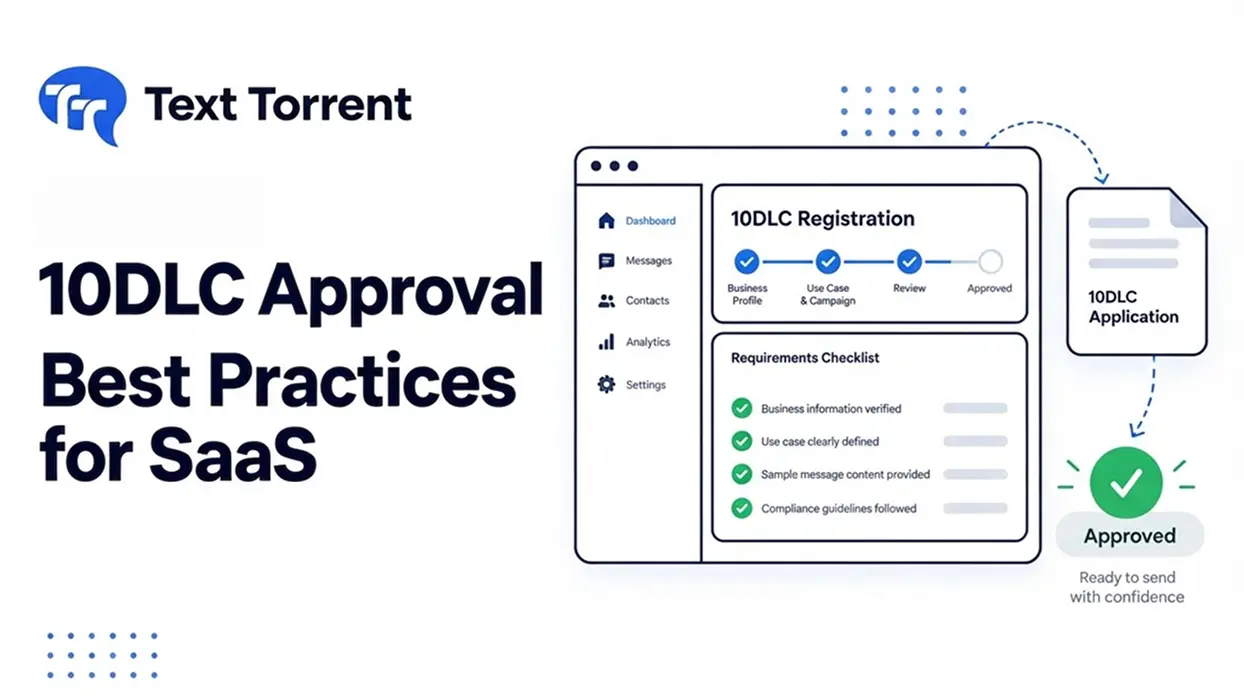
Before submitting 10DLC registration, verify:
Business Identity
Most filtering issues happen because operational behavior drifts over time.
Examples include:
The platform itself may remain compliant on paper while traffic quality deteriorates underneath.
That is why ongoing monitoring matters.
Final Thoughts
10DLC approval for SaaS platforms is fundamentally about risk management.
Carriers want evidence that:
SaaS companies that treat compliance as an operational system — not just a registration form — generally experience smoother approvals, stronger
deliverability, and fewer long-term filtering problems.