- August 21,2026
- 1 month ago
Merchant cash advance leads often receive calls, emails, and texts from several brokers within a short period. The problem is not that prospects need no follow-up. The problem is that most follow-up feels interchangeable.
One broker sends, “Just checking in.” Another asks whether the merchant still needs funding. A third repeats an approval amount that has not been verified. By the end of the day, the business owner cannot distinguish one company from another.
The best lead follow-up strategy for MCA brokers is not the most persistent sequence. It is a system for deciding when to respond, what to ask, when to stop automating, and when to give the prospect space.
A useful follow-up reduces uncertainty. It tells the merchant who is contacting them, why the message is relevant, and what small action would move the process forward. When every message has that purpose, brokers can remain visible without behaving like another high-pressure sender.
Pushiness usually begins as an operational problem, not a copywriting problem.
Teams receive leads from several sources, but the CRM may not preserve whether the merchant requested a quote, started an application, uploaded documents, missed a call, or downloaded information. Without that context, every lead receives the same sequence.
Automation may also continue after a representative replies. Calls, emails, and texts are scheduled independently. Several people contact the same business. The prospect experiences pressure even when each message sounds polite.
What breaks when this continues:
Opt-outs and complaints increase
Representatives duplicate work
Merchants repeat information they already provided
Qualified prospects disengage because the process feels disorganized
Reporting rewards activity instead of progress
The fix is not softer wording alone. The workflow must recognize the prospect’s current state.
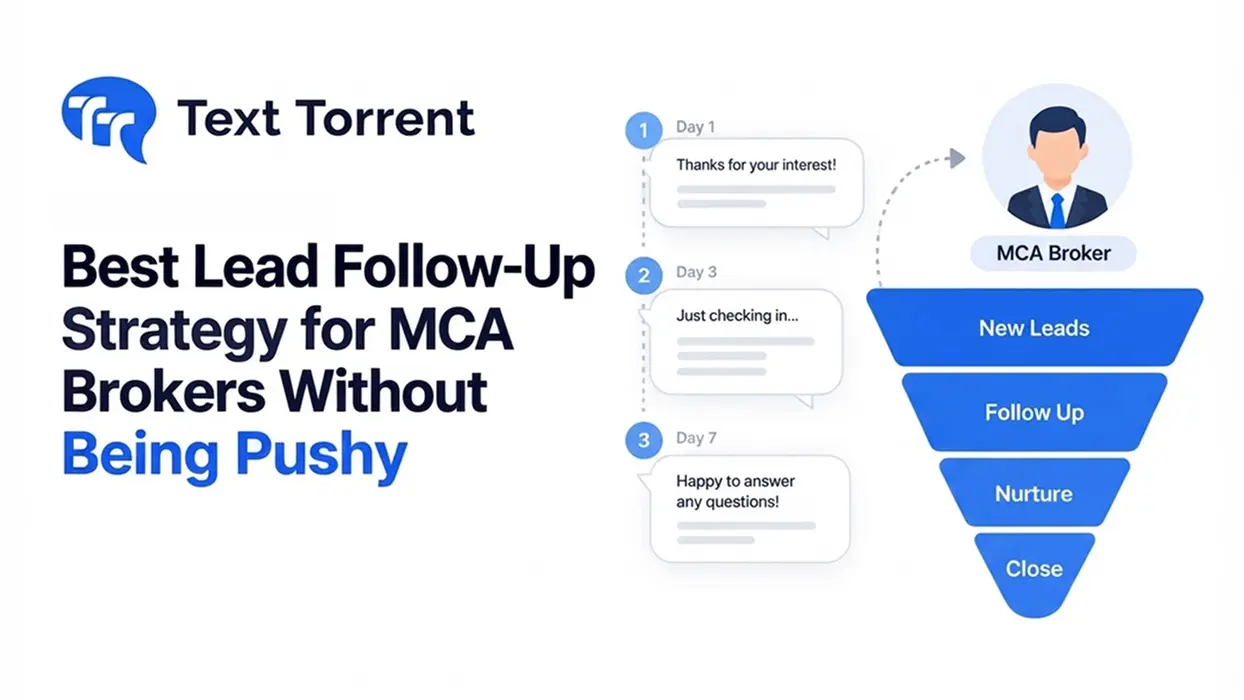
Do not use one cadence for every MCA lead. Place contacts into stages that determine the next action.
New Inquiry
The merchant recently completed a form, called, or requested information. Confirm the request and establish contact.
Contacted but Unqualified
The merchant has not provided enough information to assess basic fit. Ask one decision-changing question at a time.
Qualified and Interested
The business appears to meet initial criteria. Schedule a conversation or move to the application.
Application or Documents Pending
The process cannot continue because an application section or required document is missing. Identify the exact obstacle.
Decision Pending
The merchant has received terms or is comparing options. Answer questions without manufacturing urgency.
Future Timing
The merchant is interested but does not need capital now. Record an agreed follow-up date and stop short-term outreach.
Closed or Opted Out
The merchant declined, became ineligible, selected another provider, or requested no further contact. Suppress outreach accurately.
This model matters because elapsed time does not equal intent. A lead who started an application yesterday requires a different message from one who said, “Call me next quarter.”
A cadence should define maximum contact pressure, not guarantee that every message will be sent.
Within Five Minutes: Confirm the Request
Send a short confirmation while the inquiry is still recognizable.
Hi Marcus, this is Elena from Northline Capital. You requested information about business funding today. Are you looking to use the funds within the next 30 days? Reply YES, LATER, or STOP to opt out.
The message establishes identity, references the action, and asks one simple question.
Avoid opening with “Congratulations,” “You are approved,” or a large funding amount unless an actual decision supports it. False certainty may attract replies, but it damages trust when underwriting produces a different result.
After 30–60 Minutes: Make One Human Attempt
If the lead has not replied, the assigned representative can make one call during reasonable business hours. If unanswered, send a text only when it adds context:
I just tried to reach you about the funding request submitted today. No need to call back immediately—reply with a convenient time and I’ll work around your schedule.
This preserves momentum without demanding an immediate response.
Next Business Day: Add Useful Information
Do not repeat the first message.
To check whether the available options are worth reviewing, I only need your approximate monthly business revenue and time in business. You can reply with ranges if that is easier.
The message explains why the information is needed and lowers the effort required to respond.
Day Three: Offer a Choice
Silence can mean poor timing, uncertainty, channel preference, or lack of interest. Give the merchant control:
Would you prefer that I:
send the basic requirements,
schedule a short call, or
close the request for now?
A choice is more useful than “Are you still interested?” It also creates a clean exit.
Day Seven: Close the Active Sequence
End the immediate chase.
I haven’t heard back, so I’ll close the active follow-up for now. If business funding becomes relevant later, reply here and we can pick up from your original request. Reply STOP to opt out.
After this, remove the lead from the rapid sequence. Do not quietly move the contact into another aggressive automation.
This cadence is a baseline, not a legal safe harbor. Adjust it to the original permission, lead source, response behavior, business hours, applicable requirements, and advice from qualified counsel.
Once a merchant responds, stop the generic timer-based sequence.
Follow-up should then be triggered by an unfinished action or an agreed commitment, such as:
A requested call time
An unopened application link
An incomplete form
A missing document
A promised update
A future follow-up date
Each message should name the unfinished step.
Bad:
Just following up again. Any update?
Better:
We received the application, but the last three months of business bank statements are still missing. Once uploaded through the secure link, the file can move to review.
Specificity makes follow-up feel like service instead of pressure.
For a wider view of texting across acquisition, underwriting, and funding, see this guide to using SMS throughout the funding lifecycle.
Automation is useful before a conversation begins and for predictable reminders. It becomes harmful when it competes with a representative.
Apply five rules:
Pause prospecting messages when the merchant replies.
Assign one owner to the conversation.
Show that owner the complete contact history.
Cancel scheduled messages when the lead stage changes.
Resume automation only through an intentional workflow decision.
Shared inboxes, tagging, scheduling, and workflow tools support these controls. TextTorrent’s two-way messaging and campaign features can centralize the conversation, but the team must still define ownership and stopping rules.
Write Messages That Reduce Pressure
A non-pushy MCA message has four parts:
Identity: Who is contacting the merchant?
Context: What request or conversation is this connected to?
Reason: Why is the message being sent now?
Next step: What is the smallest useful response?
For example:
Hi Dana, this is Rob from Harbor Funding. You asked me to follow up after payroll. I can review the updated revenue range today. Would 2:00 or 4:30 work for a quick call?
The message does not invent urgency. It uses the prospect’s stated timeline.
Replace empty phrases such as “just checking in,” “touching base,” and “any update?” with the reason for contacting the merchant:
“You asked me to reconnect after Friday’s deposit.”
“The application is saved, but one section remains incomplete.”
“I received the updated statements and have one revenue question.”
“The review is complete, and I can explain the available structures.”
Do not claim that an offer expires, funds are reserved, or approval is guaranteed unless the statement is accurate and authorized. Pressure language can increase immediate replies while reducing trust later.
A phone number in a lead record does not automatically make the contact textable. Preserve the source, disclosure, date, time, and evidence required by your policy.
TextTorrent requires valid express consent and verifiable proof, and its acceptable-use policy prohibits messaging contacts who have opted out or appear on the platform’s blacklist.
Do not treat STOP as the only opt-out. Current FCC rules allow recipients to revoke consent through any reasonable method that clearly communicates a desire to stop, and senders may not force one exclusive method.
Suppress messages when someone writes “remove me,” “do not contact me,” “wrong number,” or similar language. Apply the suppression across campaigns, individual inboxes, CRM workflows, and future imports.
A2P 10DLC registration is part of the sending infrastructure, but it does not replace consent or responsible campaign behavior. Teams unfamiliar with the process should review how business sender registration works.
Track qualified conversations, completed applications, document completion, and funded outcomes—not only call and message counts.
Contacting Every Source with the Same Intensity
A direct website inquiry, referral, aged lead, and existing customer entered through different contexts. Their follow-up should reflect that difference.
Allowing Several Brokers to Contact One Merchant
Duplicate outreach makes the business look fragmented and destroys reliable attribution.
Sending Unexplained Links
Financial links can look suspicious. Identify the destination and explain what the merchant will do there.
Asking for Sensitive Data by Text
Use SMS to prompt action, not to collect bank credentials, Social Security numbers, tax records, or confidential documents. Move those steps to a secure portal.
Trying to Bypass Filtering
Changing numbers, domains, or wording to evade carrier controls does not repair weak consent or complaint patterns. Review the operational causes behind carrier filtering and message blocking.
Pressure appears in recipient behavior. Monitor:
Opt-outs and negative replies by source
Duplicate-contact incidents
Time to first meaningful response
Reply-to-conversation rate
Conversation-to-application rate
Application completion rate
Messages sent after a reply or stage change
Complaints and delivery errors
Funded deals by source
Review actual threads, not only dashboards. Aggregate results can hide repeated questions, broken handoffs, and messages sent after a merchant declined.
When one step produces a sharp increase in opt-outs or negative replies, pause it. Inspect the lead source, wording, timing, and frequency before sending more traffic.
Before activating a sequence, confirm:
The contact has a documented reason to receive messages
The first message identifies the sender and inquiry source
One representative owns the lead
Calls, texts, and emails follow one coordinated plan
Every message has a distinct purpose
Generic automation stops after a reply
The workflow changes when the lead stage changes
Sensitive information moves through a secure process
Natural-language opt-outs are recognized
The final message closes the rapid sequence
Reporting measures stage progress and funded results
The best lead follow-up strategy for MCA brokers is persistent enough to prevent good inquiries from being forgotten but controlled enough to respect the merchant’s attention.
Respond quickly. Preserve the context of the original request. Ask one useful question at a time. Replace repetitive check-ins with specific next steps. Stop generic automation when a person responds, and close the rapid sequence when continued contact no longer adds value.
MCA brokers do not avoid being pushy by disappearing after one attempt. They avoid it by making every follow-up accurate, relevant, coordinated, and easy to decline.