- August 21,2026
- 1 month ago
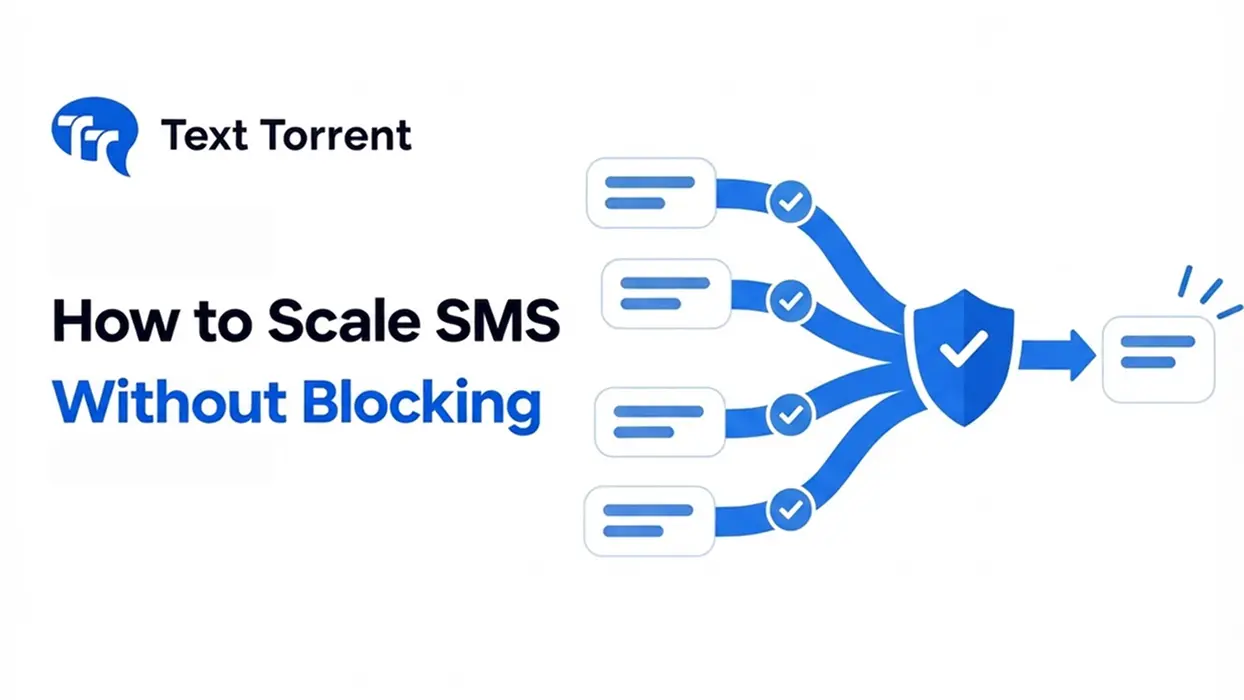
Scaling SMS campaigns is one of the most misunderstood challenges in business messaging.
Many businesses focus almost entirely on increasing volume. They purchase additional numbers, expand contact databases, launch larger campaigns, and automate more workflows. Initially, everything appears successful.
Then problems begin.
Delivery rates decline. Carrier filtering increases. Messages stop reaching customers consistently. Some campaigns experience outright blocking. Engagement drops while costs continue rising.
The mistake is assuming that scaling SMS is primarily a volume problem.
In reality, scaling is a trust problem.
The larger your messaging program becomes, the more attention carriers pay to how you operate. Practices that work for a campaign sending 1,000 messages per month may cause serious deliverability issues. This can happen when you send 100,000 or 1 million messages per month.
Scaling SMS without getting blocked takes planning. Carriers look at risk. Your sender reputation builds over time. Small mistakes get bigger as traffic increases.
Before discussing scaling, it is important to understand what businesses are trying to avoid.
Carrier blocking occurs when a mobile carrier prevents messages from reaching recipients.
Unlike filtering, where some traffic may still be delivered, blocking can stop large portions of traffic entirely.
Blocking is typically associated with:
Severe compliance issues
Unregistered traffic
Fraud indicators
Repeated carrier violations
Extremely poor sender reputation
High-risk messaging behavior
The important takeaway is that blocking rarely happens without warning.
Most businesses experience smaller trust-related problems before reaching that stage.
Many organizations assume that if a campaign works today, it will continue working at ten times the volume.
That assumption is often wrong.
Carriers evaluate more than message content.
They also monitor:
Traffic patterns
Complaint rates
Consent quality
Reputation history
Registration accuracy
Volume growth
As traffic expands, weaknesses become more visible.
A campaign sending 500 messages per day may receive little scrutiny.
A campaign sending 50,000 messages per day receives far more attention.
Scaling exposes operational problems that previously remained hidden.
One of the most common reasons large-scale SMS programs encounter delivery problems is poor database quality.
As databases grow, they naturally accumulate:
Invalid numbers
Disconnected numbers
Inactive subscribers
Outdated records
Many businesses focus on acquisition while neglecting maintenance.
This creates risk.
Carriers monitor delivery quality. Large numbers of failed deliveries can contribute to negative trust signals.
What Businesses Get Wrong
Many organizations assume that more contacts automatically create better results.
In reality, 50,000 engaged contacts often outperform 200,000 low-quality contacts.
Best Practice
Regularly remove:
Invalid records
Known delivery failures
Long-term inactive subscribers
List quality becomes increasingly important as campaign volume grows.
One of the fastest ways to attract carrier scrutiny is sudden traffic growth.
Consider two scenarios.
A sender increases volume gradually:
1,000 messages per day
2,000 messages per day
5,000 messages per day
10,000 messages per day
Scenario B
A sender jumps from:
1,000 messages per day
To 100,000 messages per day overnight
The second scenario creates significantly more risk.
Why Carriers Care
Many spam campaigns scale rapidly.
As a result, sudden volume increases often trigger additional monitoring.
Operational Rule
Treat traffic growth as a gradual process rather than a single event.
Predictable growth generally creates stronger trust signals.
Reputation is one of the most important factors influencing long-term deliverability.
Unfortunately, many businesses pay attention only after problems begin.
Carriers evaluate reputation using multiple signals.
These often include:
Complaints
Opt-outs
Historical delivery patterns
Engagement quality
Traffic consistency
Why Reputation Matters During Scaling
At small volume, occasional negative signals may have minimal impact.
At large volume, those same signals become much more significant.
Monitor Continuously
Track:
Complaint rates
Opt-out rates
Delivery trends
Engagement patterns
Do not wait for delivery rates to collapse before investigating reputation issues.
Consent quality becomes increasingly important as programs expand.
Many blocking events originate from weak consent management rather than technical failures.
Recipients who do not expect messages are more likely to:
Ignore messages
Opt out
Submit complaints
These signals directly affect carrier trust.
Common Scaling Mistake
Businesses often expand using:
Old lead databases
Purchased lists
Poorly documented opt-ins
The resulting complaints frequently create deliverability issues.
Practical Decision Rule
If a recipient would be surprised to receive a message, the consent process should be reviewed.
Warm New Numbers Properly
Additional numbers are often required when scaling.
However, new numbers introduce unique challenges.
Carriers possess little historical information about newly activated numbers.
As a result, trust levels are lower initially.
Purchase new numbers and immediately assign large campaign volumes.
What Usually Works Better
Increase traffic gradually.
Allow positive delivery signals to accumulate over time.
Number warming helps establish trust before significant traffic is introduced.
Keep Registration Information Accurate
Registration is not a one-time task.
Many businesses complete registration and never review it again.
The problem is that messaging programs evolve.
Businesses may change:
Campaign objectives
Traffic volume
Consent methods
Message types
When actual behavior no longer matches registration information, trust issues can emerge.
What Happens If Ignored
Carriers may view traffic as higher risk.
Filtering may increase.
Blocking risk may rise.
Review registration information regularly and update it whenever messaging practices change significantly.
Automation is essential for scaling.
However, excessive automation often creates unexpected problems.
As workflows multiply, recipients may receive:
Promotional campaigns
Follow-up sequences
Reminder messages
Customer notifications
All within short periods.
Why This Creates Risk
Message frequency increases.
Customer frustration increases.
Complaints become more likely.
Better Approach
Review automation from the subscriber's perspective.
Evaluate total message frequency rather than individual workflows.
As databases expand, audience diversity increases.
The same message rarely performs equally well across all subscriber groups.
Many businesses continue sending broad campaigns to increasingly different audiences.
Consequences
Lower engagement
Higher opt-outs
More complaints
Over time, these signals influence deliverability.
Effective Segmentation Factors
Consider:
Customer status
Purchase history
Geographic location
Engagement behavior
Product interests
More relevant messaging generally creates stronger trust signals.
Monitor Carrier-Specific Performance
Many organizations focus only on overall delivery metrics.
This creates a visibility problem.
For example:
Carrier A: 98% delivery
Carrier B: 97% delivery
Carrier C: 82% delivery
The overall average may still appear acceptable.
Meanwhile, one carrier network experiences significant problems.
Why This Matters
Blocking and filtering often begin on specific carrier networks before affecting others.
Operational Rule
Review carrier-specific reporting regularly.
Problems are easier to solve when identified early.
Investigate Small Delivery Changes Early
One of the most expensive mistakes businesses make is ignoring small declines.
Blocking rarely occurs without warning.
Early indicators often include:
Slight delivery declines
Increased opt-outs
Reduced engagement
Carrier-specific inconsistencies
Higher complaint rates
Many teams dismiss these signals because campaigns continue generating results.
Over time, those small problems accumulate.
Treat every delivery decline as a potential early-warning signal.
Investigating early is usually far easier than recovering from large-scale blocking events.
SMS Scaling Without Blocking Checklist
Before increasing campaign volume, confirm the following:
Contact Quality
Invalid numbers removed
Inactive subscribers removed
Consent records maintained
Reputation Health
Complaint rates remain low
Opt-out rates remain stable
Delivery trends remain strong
Compliance
Registration information is current
Messaging behavior matches approved use cases
Consent documentation exists
Traffic Growth
Volume increases gradually
New numbers are warmed properly
Throughput plans are realistic
Reporting
Delivery rates monitored
Acceptance rates monitored
Carrier-specific performance reviewed
Organizations that consistently review these areas are significantly less likely to encounter blocking-related issues.
What Successful Scaling Looks Like
A healthy scaling program does not simply send more messages.
It maintains operational quality while increasing volume.
For example:
Poor Scaling
Volume doubles
Complaints increase
Delivery declines
Filtering increases
Healthy Scaling
Volume doubles
Delivery remains stable
Complaints remain low
Engagement remains consistent
The difference is not volume.
The difference is operational discipline.
Final Thoughts
Scaling SMS without blocking is not primarily about technology. It is about maintaining carrier trust as traffic grows.
Businesses that scale successfully focus on clean contact data, strong consent practices, sender reputation, gradual traffic growth, accurate registrations, thoughtful automation, and continuous monitoring. They understand that carriers evaluate behavior patterns over time and that trust must be earned continuously.
The organizations most likely to avoid blocking are not necessarily those with the most sophisticated campaigns. They are the ones that maintain consistent operational practices while expanding volume. By treating scaling as reputation management, not a volume goal, businesses can grow SMS programs. They can also protect deliverability, compliance, and long-term performance.