- August 21,2026
- 1 month ago
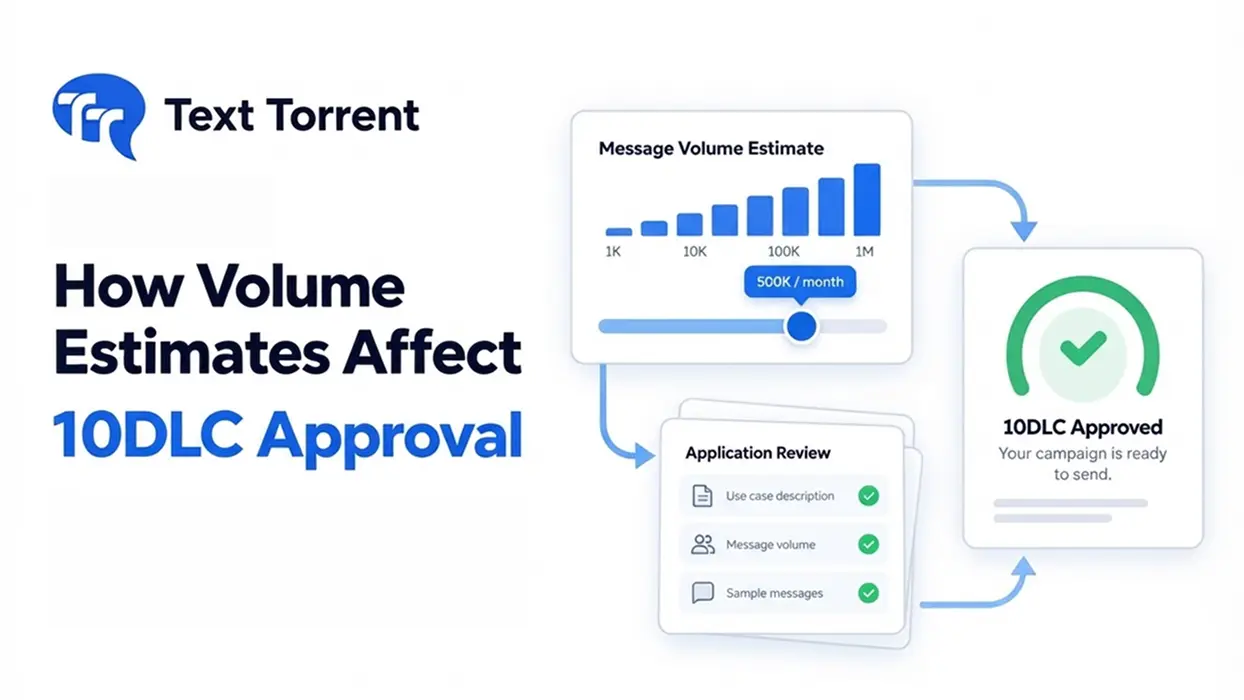
Volume estimates are one of the most misunderstood parts of the 10DLC registration process.
Many businesses assume the “estimated monthly volume” field is just informational. In reality, carriers use it as a risk signal that influences campaign review, throughput expectations, filtering sensitivity, and long-term trust evaluation.
The problem is not simply sending “too many” messages. The problem is when actual traffic behavior does not align with what was declared during registration.
This is where many campaigns begin experiencing approval delays, manual reviews, or filtering later.
10DLC was designed to give carriers visibility into business messaging behavior.
Volume estimates help carriers evaluate:
Expected traffic patterns
Campaign scale
Risk exposure
Infrastructure impact
Spam probability
A campaign sending 500 appointment reminders per month behaves very differently from one sending 2 million marketing messages.
The review process changes accordingly.
Volume estimates help carriers decide how aggressively traffic should be monitored from the beginning.
Carriers do not look at volume in isolation.
They evaluate volume together with:
Campaign type
Business category
Opt-in model
Message content
Historical reputation
Sending consistency
For example:
A national retailer sending large authenticated traffic may appear normal
A newly registered company requesting massive volume immediately may trigger scrutiny
The same number can represent either legitimate scale or elevated risk depending on context.
Many businesses intentionally submit low estimates hoping for faster approval.
This often backfires later.
What Usually Happens
A campaign may register with:
“5,000 messages monthly”
But actual traffic quickly becomes:
250,000 messages monthly
That mismatch creates behavioral inconsistencies between:
Declared intent
Observed carrier traffic
Carriers monitor those changes continuously.
Common Consequences
Large traffic deviations can contribute to:
Increased filtering
Throughput restrictions
Manual reviews
Carrier audits
Messaging slowdowns
The approval itself may remain active, but traffic quality scoring can deteriorate quietly over time.
Inflated estimates create a different problem.
Some businesses submit unrealistic numbers because they believe higher volume means higher throughput approval.
That assumption is often incorrect.
Example
A local service business claiming:
“5 million monthly messages”
without a matching infrastructure footprint or customer base may appear suspicious during review.
Carriers expect estimates to align with operational reality.
Unrealistic projections can create questions about:
Lead sourcing
Consent quality
Intended messaging behavior
Spam risk
Not all traffic categories carry the same compliance sensitivity.
Lower-Risk Traffic Examples
These usually tolerate higher consistency more easily:
Appointment reminders
Account alerts
Two-factor authentication
Service notifications
Higher-Risk Traffic Examples
These receive heavier scrutiny:
Affiliate marketing
Lead generation
Mass promotional campaigns
Political messaging
Sweepstakes traffic
A marketing campaign sending 500,000 messages may face stricter evaluation than a notification system sending the same volume.
The use case matters.
One of the biggest operational mistakes happens after approval.
Businesses gradually warm up campaigns, then suddenly launch aggressive outbound blasts.
Example:
Week 1: 2,000 messages/day
Week 2: 3,500 messages/day
Week 3: 120,000 messages/day
That pattern resembles spam escalation behavior.
Even compliant campaigns may experience filtering when growth becomes abnormal relative to historical behavior.
Carriers are primarily evaluating predictability.
Healthy messaging systems tend to show:
Stable traffic growth
Consistent engagement
Low complaint rates
Reliable opt-in quality
Reasonable sending patterns
Unstable systems usually show:
Sharp volume bursts
Repetitive content
Poor engagement
High opt-out rates
Complaint spikes
Volume alone is rarely the root problem. Behavioral inconsistency is.
Businesses often struggle because they guess randomly during registration.
A better approach is to calculate realistic operational projections.
Practical Estimation Formula
Estimate:
Active users
Average messages per user
Monthly campaign frequency
Example:
8,000 customers
3 messages monthly
24,000 estimated monthly messages
That estimate is operationally defensible.
Many startups project traffic based on ideal growth scenarios rather than current reality.
Carriers care more about believable operational behavior than ambitious projections.
Start Conservatively
New campaigns should ramp traffic gradually.
Even approved campaigns benefit from predictable growth patterns.
Separate Traffic Types
Do not combine:
Marketing
Customer care
Notifications
Authentication traffic
under one campaign if behavior differs significantly.
Separate campaigns create cleaner reputation profiles.
Monitor Engagement Early
High opt-out rates during early scaling periods are dangerous.
Watch closely for:
STOP responses
Complaint increases
Delivery degradation
Reduced response rates
Early warning signs usually appear before full filtering occurs.
Treating Registration as Permanent Approval
Approval is not the end of compliance monitoring.
Traffic behavior remains under evaluation continuously.
Ignoring Traffic Consistency
Teams often focus only on sending capacity.
Carriers focus heavily on behavioral stability.
Scaling Faster Than Reputation Builds
Trust scoring improves gradually.
Trying to force enterprise-scale traffic through newly registered campaigns creates risk.
Before registering or scaling traffic, verify:
Monthly estimates reflect realistic usage
Campaign type matches actual behavior
Opt-in quality is documented
Traffic growth plans are gradual
Marketing and transactional traffic are separated
Sample messages match real sending behavior
Volume estimates affect more than registration paperwork.
They help carriers establish expectations around how your campaign should behave operationally.
The safest approach is not choosing the “lowest” or “highest” number. It is choosing a realistic estimate that matches actual business behavior.
Campaigns that scale gradually, maintain clean consent practices, and stay consistent with their declared use case generally experience fewer filtering problems and more stable long-term deliverability.