- August 21,2026
- 1 month ago
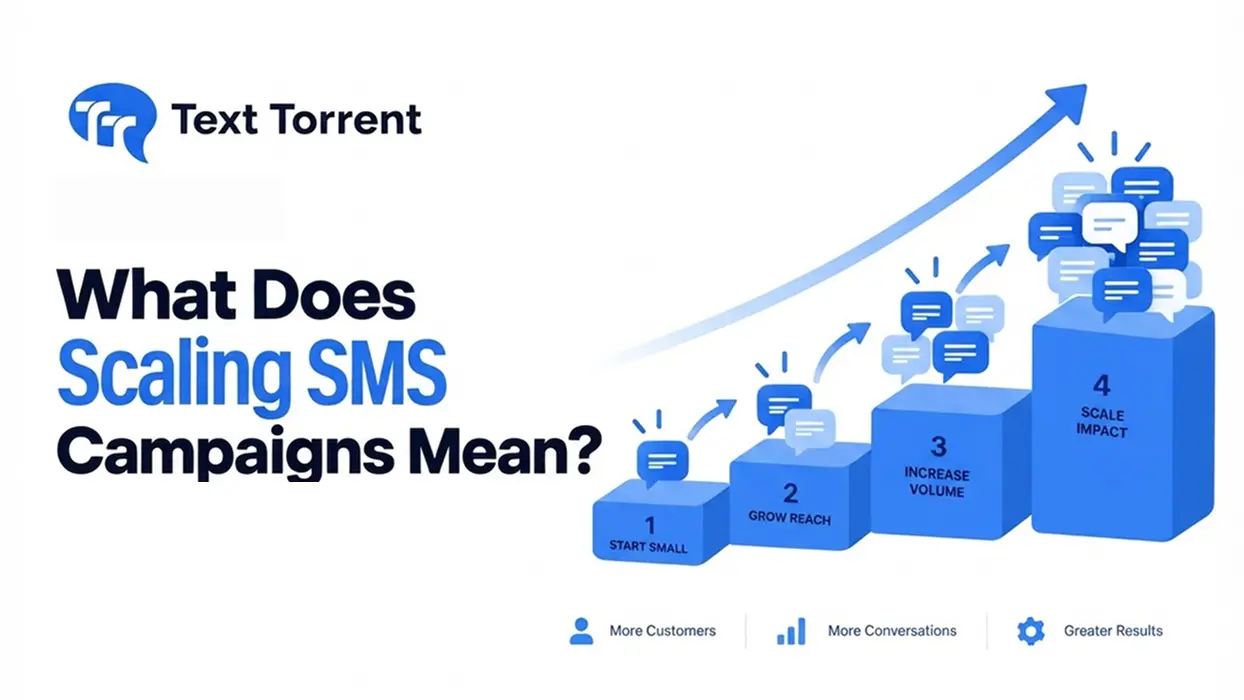
Many businesses believe scaling SMS campaigns simply means sending more messages.
That definition is incomplete.
Sending 1,000 messages instead of 100 is not necessarily scaling. In many cases, it is simply increasing volume.
True SMS campaign scaling means increasing messaging volume, audience size, and business impact while maintaining deliverability, compliance, sender reputation, and campaign performance.
This matters because many SMS programs work well at low volumes but face delivery issues as traffic grows. Carrier filtering, reputation problems, and lower engagement can also increase over time.
Understanding what scaling SMS campaigns actually means helps businesses expand successfully without creating the operational problems that often accompany rapid growth.
A campaign that sends 500 messages per week operates very differently from a campaign sending 500,000 messages per month.
At lower volumes, many problems remain hidden.
Examples include:
Weak list hygiene
Poor consent management
Inconsistent sending behavior
Incomplete compliance processes
Reputation issues
As traffic increases, carriers become more sensitive to these weaknesses.
This is why some businesses experience declining results immediately after increasing volume.
The challenge is not the additional messages.
The challenge is that larger messaging programs require stronger operational controls.
Most successful SMS programs scale across four areas simultaneously.
The subscriber base expands through:
Lead generation
Customer acquisition
Website opt-ins
Existing customer programs
More contacts create more messaging opportunities.
However, growth without quality controls often introduces delivery risks.
Message Volume Growth
As audiences expand, message volume increases.
This includes:
Promotional campaigns
Notifications
Appointment reminders
Customer updates
Automated workflows
Volume alone does not indicate successful scaling.
The quality of that volume matters.
Scaling requires better processes.
Examples include:
Consent tracking
Compliance management
Performance monitoring
Reputation management
Contact maintenance
Many businesses underestimate this requirement.
Infrastructure Growth
Larger messaging programs often require:
Additional sending numbers
Throughput management
Traffic scheduling
Reporting systems
Automation workflows
Without supporting infrastructure, growth becomes difficult to sustain.
One of the most common misconceptions is that successful small campaigns automatically become successful large campaigns.
In reality, scaling introduces new risks.
Carrier Scrutiny Increases
Carriers monitor higher-volume traffic more closely.
As messaging activity grows, additional attention is placed on:
Reputation
Consent quality
Complaint rates
Traffic patterns
Problems that were insignificant at low volumes become more visible at scale.
A database containing 1,000 contacts can tolerate some inaccuracies.
A database containing 500,000 contacts cannot.
Small data-quality issues become major deliverability issues when multiplied across large audiences.
Operational Mistakes Become Expensive
A campaign mistake affecting 100 recipients is manageable.
The same mistake affecting 100,000 recipients can create:
Complaint spikes
Opt-out surges
Reputation damage
Scaling amplifies both strengths and weaknesses.
Several mistakes appear repeatedly as messaging programs grow.
Scaling Too Quickly
Many organizations increase volume dramatically without establishing a reputation history.
For example:
500 messages daily
Then 50,000 messages overnight
This pattern often attracts additional carrier scrutiny.
Ignoring Consent Quality
Growth sometimes encourages aggressive list expansion.
Poor-quality leads often generate complaints and opt-outs.
Adding New Numbers Aggressively
New numbers have limited reputation history.
Immediate high-volume sending can increase filtering risk.
Monitoring Only Campaign Results
Many businesses focus on:
Clicks
Replies
Conversions
While ignoring:
Delivery rates
Acceptance rates
Complaint trends
Deliverability problems often emerge before campaign performance declines.
Poor scaling practices typically create predictable problems.
Delivery Rates Decline
Carrier trust may weaken as traffic volume grows.
Higher-risk traffic receives additional scrutiny.
Complaint Rates Rise
Larger audiences often include lower-quality contacts.
Negative engagement signals accumulate over time.
Performance Becomes Unpredictable
Campaign results become inconsistent across carriers and audiences.
These issues frequently appear gradually rather than all at once.
Healthy scaling produces growth without sacrificing performance.
A well-managed messaging program should maintain:
Strong delivery rates
Stable reputation
Low complaint rates
Consistent engagement
Compliance alignment
Volume increases should not automatically cause performance declines.
Practical Example
Scenario A:
10,000 contacts
98% delivery rate
1% complaint rate
Six months later:
100,000 contacts
98% delivery rate
Similar complaint rate
This represents successful scaling.
Scenario B:
10,000 contacts
98% delivery rate
Six months later:
100,000 contacts
89% delivery rate
Rising complaints
This represents volume growth without operational scaling.
Several practices consistently improve long-term scalability.
Maintain Contact Quality
Regularly remove:
Invalid numbers
Inactive subscribers
Problematic contacts
List quality becomes increasingly important as audiences grow.
Scale Volume Gradually
Avoid dramatic traffic increases.
Consistent growth generally creates stronger trust signals.
Monitor Reputation
Track:
Complaints
Opt-outs
Delivery trends
Engagement changes
These indicators often reveal emerging problems early.
Review Compliance Regularly
Ensure registrations, campaign descriptions, and consent processes remain accurate as programs evolve.
Warm New Numbers
Allow new numbers to establish positive performance history before assigning significant traffic.
Before increasing campaign volume, verify:
Audience Quality
Consent records are documented
Invalid contacts are removed
Subscriber expectations are clear
Reputation Health
Complaint rates remain low
Opt-outs remain stable
Delivery performance is strong
Compliance Status
Registration information is current
Messaging behavior matches approved use cases
Traffic Management
Volume growth is planned
New numbers are warmed appropriately
Throughput requirements are understood
Reporting
Delivery rates are monitored
Acceptance rates are reviewed
Carrier-specific performance is tracked
Final Thoughts
Scaling SMS campaigns does not simply mean sending more messages. It means increasing audience size, messaging volume, and business impact while maintaining deliverability, compliance, sender reputation, and customer experience.
Many businesses do well at low volumes but face problems as campaigns grow. This happens because higher traffic exposes operational weaknesses.
Organizations that scale successfully focus on more than volume. They maintain clean contact data, protect reputation, monitor deliverability, manage compliance carefully, and expand traffic gradually. By treating scaling as an operational discipline, not a volume goal, businesses can grow messaging programs. They can also keep reliable performance over time.