- August 21,2026
- 1 month ago
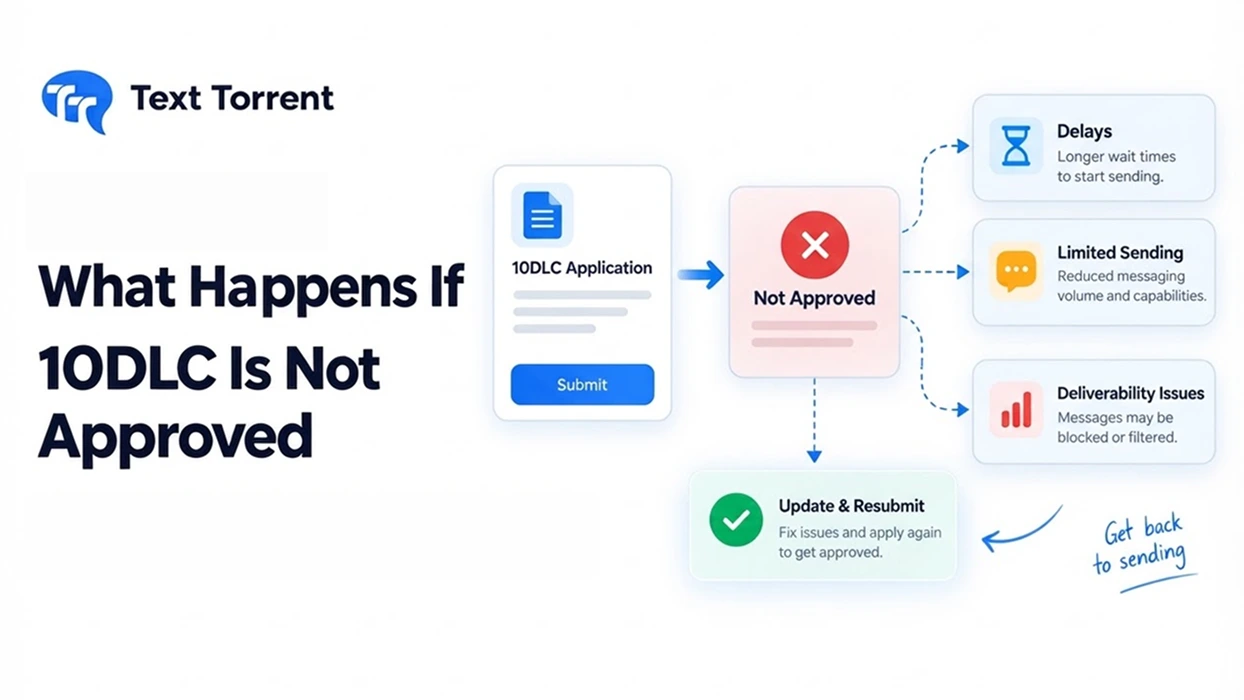
A2P 10DLC approval is not a formality. It is the control layer that determines whether your SMS traffic is trusted, limited, or blocked in the U.S. carrier ecosystem.
If your 10DLC registration is not approved, messaging does not simply “work with lower performance.” In most cases, it either doesn’t send at all or operates under severe restrictions that make scaling impossible.
This guide breaks down what actually happens when 10DLC is not approved, why it happens, and how to correct it without delaying your messaging operations further.
10DLC approval has two distinct components:
Brand registration (your business identity)
Campaign registration (how you plan to use messaging)
Failure can happen at either layer.
Scenarios:
Brand rejected → you cannot register campaigns
Campaign rejected → you cannot send approved traffic
Pending too long → messaging remains restricted
Each scenario affects delivery differently, but all lead to reduced or blocked messaging capability.
1. Messaging Is Blocked or Severely Limited
What happens
If your campaign is not approved:
Outbound messaging is often disabled
Messages may fail silently or return errors
Some platforms restrict sending entirely
Even if sending is technically allowed in limited cases, traffic is treated as unregistered, which is high-risk.
What breaks if ignored
Campaigns don’t launch on time
Automation workflows fail
Customer communication becomes unreliable
Common mistake
Teams assume they can “start sending now and fix registration later.”
In reality, carriers deprioritize or block unregistered traffic quickly.
2. Unregistered Traffic Gets Filtered Aggressively
What happens
Without approval, your messages:
Lack a verified identity
Have no declared use case
Carry no trust score
Carriers treat this as unknown or potentially abusive traffic.
Result
Messages may show as “sent” but never reach the user
Delivery becomes inconsistent
Engagement drops sharply
What breaks if ignored
False sense of delivery success
Wasted campaign spend
Poor data for decision-making
Operational reality
Unapproved traffic doesn’t scale. Even small volumes can get filtered if patterns look risky.
3. Throughput Is Restricted or Nonexistent
What happens
Approved campaigns receive assigned throughput levels (how many messages per second/minute you can send).
Without approval:
Throughput is either extremely low or zero
Messages queue or fail under load
What breaks if ignored
Large campaigns cannot execute
Time-sensitive messaging becomes unreliable
Delivery delays increase unpredictably
Common mistake
Trying to send high-volume campaigns from unapproved campaigns.
This often triggers immediate filtering or blocking.
4. Carrier Trust Score Is Never Established
What happens
Approval assigns a trust score based on:
Business legitimacy
Use case clarity
Risk profile
Without approval:
No trust score exists
No pathway to increase throughput
No baseline for carrier confidence
What breaks if ignored
You cannot “improve” delivery over time
Performance remains unstable
Scaling becomes impossible
Important nuance
Trust is cumulative. Starting without approval means you’re operating outside the system that builds it.
5. Compliance Risk Increases
What happens
10DLC is not just a technical requirement—it’s tied to compliance frameworks (CTIA, carrier policies).
Without approval:
Your traffic is considered non-compliant
Complaint risk increases
Carrier enforcement becomes more likely
What breaks if ignored
Campaign suspension
Number blocking
Long-term damage to sender reputation
Common mistake
Treating 10DLC as optional for “low-risk” messaging like reminders or follow-ups.
All A2P messaging requires alignment.
6. Campaign Approval Delays Compound Operational Problems
What happens
If your registration is rejected or delayed:
Launch timelines slip
Marketing campaigns stall
Customer communication workflows break
Root causes of delays
EIN and business name mismatch
Weak or vague use case description
Missing opt-in details
Website does not clearly reflect messaging intent
What breaks if ignored
Repeated rejections
Longer approval cycles
Internal confusion across teams
Understanding rejection reasons is critical to fixing them quickly.
1. Business Identity Mismatch
EIN does not match legal business name
Incorrect formatting (LLC vs INC differences)
2. Weak Use Case Definition
Too vague (“customer communication”)
Not aligned with actual message content
3. Missing Opt-In Clarity
No clear consent mechanism
No disclosure of message frequency or purpose
4. Poor Website Validation
No visible connection between business and messaging use
Missing privacy policy or contact details
5. Mixed Use Cases in One Campaign
Combining promotions, alerts, and support in a single registration
Step 1: Validate Business Information
Ensure EIN and legal name match exactly
Use official documents as reference
Step 2: Rewrite the Use Case Clearly
Be specific about message type
Include examples of real messages
Avoid generic descriptions
Step 3: Strengthen Opt-In Documentation
Show how users consent
Include exact language used
Clarify frequency and purpose
Step 4: Align Website With Messaging
Add clear descriptions of SMS usage
Ensure privacy policy is visible
Match business identity across all pages
Step 5: Separate Campaign Types
Register different campaigns for different use cases
Avoid mixing promotional and transactional traffic
Before submitting or resubmitting, confirm:
Business Accuracy
Does EIN match legal business name exactly?
Is the business verifiable online?
Use Case Clarity
Is the messaging purpose specific and consistent?
Are real examples included?
Consent Integrity
Is opt-in clearly documented?
Are disclosures complete?
Website Alignment
Does your site reflect your messaging use case?
Are policies visible and consistent?
Campaign Structure
Are use cases separated logically?
Is messaging behavior predictable?
If registration is rejected → fix root cause, don’t resubmit unchanged
If approval is delayed → verify EIN and use case clarity first
If messaging is urgent → do not bypass registration, accelerate approval instead
If scaling is planned → ensure campaign structure is correct before approval
Most platforms treat 10DLC as a submission task.
Texttorrent treats it as an operational dependency.
Before submission, the system ensures:
Business identity matches carrier records
Use case aligns with real messaging behavior
Campaign structure supports scaling
If issues arise:
Mismatches are identified early
Submissions are corrected before resubmission
Approval delays are reduced through proper validation
This prevents repeated rejection cycles and allows campaigns to move forward without unnecessary delays.
If 10DLC is not approved, SMS doesn’t just perform worse—it becomes unreliable, restricted, or completely blocked.
The system is designed this way intentionally:
No approval → no trust
No trust → no delivery at scale
Most failures are not random. They come from:
Misaligned business data
Weak use case definitions
Poor consent documentation
Fix those, and approval follows.
Ignore them, and messaging never stabilizes.