- August 21,2026
- 1 month ago
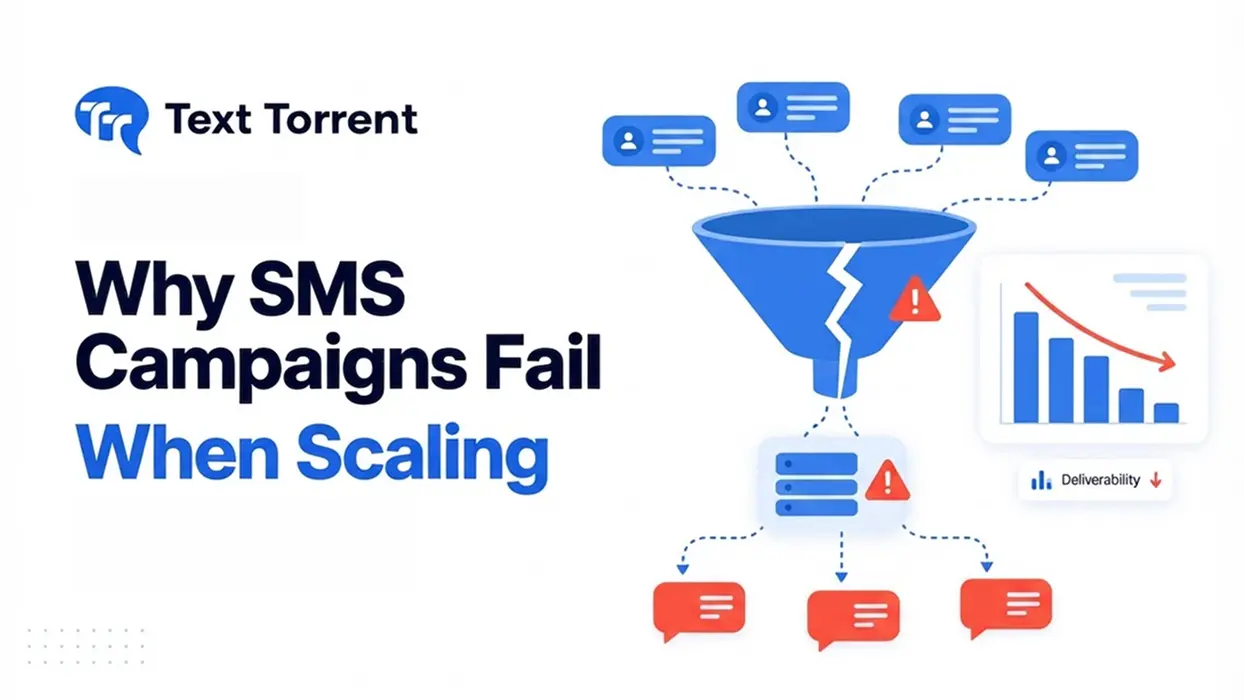
Many SMS campaigns perform exceptionally well in the beginning.
A business starts with a few hundred contacts, sends periodic messages, generates replies, and sees strong engagement. Delivery rates remain high, complaints stay low, and the program appears easy to manage.
Then growth begins.
The contact database expands. Campaign volume increases. Additional numbers are added. Marketing teams send more frequently. Automation workflows become more complex.
Suddenly, results begin to deteriorate.
Delivery rates decline. Complaint rates rise. Carrier filtering increases. Engagement drops. Costs increase while performance becomes less predictable.
This is one of the most common challenges in business messaging.
The issue is not that SMS stops working at scale. The issue is that many businesses attempt to scale volume without scaling the operational systems that support it.
Understanding why SMS campaigns fail when scaling helps businesses avoid the mistakes that frequently destroy deliverability, reputation, and long-term campaign performance.
Many organizations define scaling as sending more messages.
That definition is incomplete.
True scaling means increasing:
Audience size
Message volume
Campaign frequency
Revenue impact
Automation complexity
While maintaining:
Delivery rates
Sender reputation
Compliance
Customer experience
Engagement performance
Sending ten times more messages is easy.
Maintaining the same level of performance while sending ten times more messages is the difficult part.
That is where most SMS programs fail.
Many weaknesses remain invisible at low volume.
For example:
A few invalid contacts may not noticeably affect delivery rates.
Occasional complaints may not impact reputation.
Inconsistent consent practices may not trigger immediate consequences.
Poor segmentation may still generate acceptable results.
As volume increases, those same issues become magnified.
A problem affecting 50 contacts may be insignificant.
The same problem affecting 50,000 contacts can damage sender reputation, trigger carrier scrutiny, and reduce overall campaign effectiveness.
Scaling exposes weaknesses that already existed.
It does not create them.
One of the most common causes of scaling failure is contact database deterioration.
Businesses often focus heavily on subscriber acquisition while investing very little effort in maintaining list quality.
As databases grow:
Invalid numbers accumulate
Disconnected numbers remain active
Inactive subscribers stay on lists
Old consent records become unreliable
At small volume, these issues may appear manageable.
At scale, they become major deliverability problems.
Poor contact quality often leads to:
Higher delivery failures
Increased complaint rates
Reduced engagement
Lower carrier trust
Establish regular list-cleaning processes.
Remove:
Invalid contacts
Long-term inactive subscribers
Known delivery failures
Healthy databases scale far more effectively than neglected ones.
Many businesses attempt to accelerate growth by dramatically increasing traffic.
For example:
1,000 messages per day
Then 50,000 messages per day
From the business perspective, this may seem logical.
From the carrier perspective, it resembles traffic patterns frequently associated with spam operations.
Carriers evaluate behavior patterns.
Sudden traffic spikes often trigger additional scrutiny because abusive messaging campaigns commonly operate this way.
What Happens If Ignored
Businesses may experience:
Increased filtering
Reduced delivery rates
Throughput restrictions
Reputation challenges
Better Approach
Scale gradually.
Consistent growth generally creates stronger trust signals than dramatic volume increases.
Consent becomes more difficult to manage as databases grow.
Many organizations begin with strong opt-in practices but gradually loosen standards while expanding.
Examples include:
Importing old leads
Using questionable lead sources
Expanding acquisition channels
Sending messages beyond original expectations
Why This Creates Problems
Recipients who do not expect communication are more likely to:
Ignore messages
Opt out
Complain
Carriers monitor these behaviors closely.
Operational Rule
If a recipient would be surprised to receive a message, consent quality should be reviewed immediately.
Many businesses monitor campaign performance but fail to monitor reputation.
This creates a dangerous blind spot.
Carriers continuously evaluate:
Complaints
Opt-outs
Delivery consistency
Historical behavior
Traffic quality
Reputation influences future delivery outcomes.
The Problem
Reputation damage usually develops slowly.
By the time delivery rates decline noticeably, trust may already be weakening.
What to Monitor
Track:
Complaint rates
Opt-out trends
Delivery performance
Engagement consistency
These indicators often reveal problems before campaigns begin failing.
As campaigns grow, businesses often add more sending numbers.
This is necessary for throughput and scaling.
However, many organizations immediately assign high traffic volumes to new numbers.
Why This Fails
New numbers have limited historical reputation.
Carriers possess little performance data about them.
As a result, additional scrutiny is common.
Better Approach
Warm numbers gradually.
Allow positive reputation signals to accumulate before assigning large campaign volumes.
Compliance processes that work for small campaigns often become inadequate as operations expand.
Common examples include:
Inconsistent consent documentation
Outdated registrations
Poor record keeping
Unclear campaign classifications
As traffic volume increases, compliance weaknesses become more visible.
Carriers expect registration information and actual messaging behavior to remain aligned.
Many businesses treat compliance as a setup task rather than an ongoing operational process.
A message that performs well for one audience may perform poorly for another.
As databases expand, audience diversity increases.
Many businesses continue sending broad campaigns to increasingly different groups of recipients.
Engagement declines.
Opt-outs increase.
Complaints rise.
These negative signals eventually affect deliverability.
Segment audiences based on:
Customer status
Interests
Purchase history
Engagement patterns
More relevant messaging generally produces stronger long-term performance.
Failure Point #8: Automation Expands Faster Than Oversight
Automation helps businesses scale efficiently.
However, automation also increases risk.
As workflows multiply:
Message frequency increases
Audience overlap becomes common
Monitoring becomes more difficult
Without oversight, automation can unintentionally create poor subscriber experiences.
Common Example
A recipient receives:
Promotional message
Reminder message
Follow-up sequence
Automated workflow notification
All within a short timeframe.
The result is often frustration rather than engagement.
Failure Point #9: Businesses Focus on Volume Instead of Performance
Growth metrics are easy to celebrate.
Businesses often monitor:
Subscriber growth
Messages sent
Campaign count
While ignoring:
Delivery rates
Complaint rates
Reputation trends
This creates a dangerous situation.
Volume may increase while overall campaign effectiveness declines.
Never evaluate scaling success using volume alone.
Performance quality matters more than message quantity.
Failure Point #10: Early Warning Signs Are Ignored
Most scaling failures develop gradually.
Warning signs often appear months before major performance issues emerge.
Examples include:
Slight delivery declines
Rising opt-outs
Reduced engagement
Carrier-specific issues
Increasing complaints
These indicators are frequently dismissed because campaigns continue generating results.
Eventually, the cumulative impact becomes impossible to ignore.
Best Practice
Investigate trends early.
Small problems are generally easier to fix than large ones.
Before increasing campaign volume, review four areas.
Data Quality
Contacts remain valid
Consent records are current
Inactive subscribers are removed
Reputation Health
Complaints remain low
Opt-outs remain stable
Delivery rates remain strong
Compliance
Registration information is accurate
Messaging behavior matches approved use cases
Documentation remains complete
Volume increases gradually
New numbers are warmed properly
Throughput plans are realistic
Organizations that consistently review these areas typically experience fewer scaling-related problems.
SMS Scaling Readiness Checklist
Before launching larger campaigns:
Contact data is clean
Consent records are documented
Registration information is current
Delivery rates are stable
Complaint rates remain low
New numbers are warmed gradually
Segmentation strategy is established
Automation workflows are reviewed
Reputation metrics are monitored
Carrier-level reporting is analyzed
If several of these areas are weak, scaling should be approached cautiously.
SMS campaigns rarely fail because of volume alone. Most failures occur because operational systems fail to grow alongside message volume.
Poor contact quality, weak consent practices, declining reputation, aggressive traffic growth, inadequate compliance management, ineffective segmentation, and overlooked warning signs are among the most common reasons scaling efforts break down.
The most successful messaging programs understand that scaling is not simply about sending more messages. It is about maintaining delivery performance, customer trust, carrier trust, and operational discipline while expanding audience reach.
Businesses that treat scaling as a process rather than a volume target are far more likely to achieve sustainable growth and long-term messaging success.