- July 26,2026
- 2 months ago
Carrier filtering is often discussed as if it were a content problem.
A business sends a message, delivery rates fall, and the first thought is that one word, phrase, or link caused filtering.
In reality, most carrier filtering decisions are not caused by a single message.
They are caused by a collection of risk signals.
Modern carriers evaluate sender behavior, recipient feedback, registration quality, reputation history, traffic patterns, and message characteristics simultaneously. A business can send a compliant message and still experience filtering. Likewise, another sender may use nearly identical content and see no delivery issues at all.
Understanding the most common triggers of carrier filtering is important because delivery problems rarely appear without warning. In most cases, the signals that lead to filtering have been building for weeks or months before campaign performance begins to decline.
Recognizing these warning signs early gives businesses more time to reduce carrier filtering before sender reputation and delivery performance deteriorate further.
Before examining individual triggers, it is important to understand how carriers evaluate traffic.
Filtering systems are designed to answer a simple question:
"How likely is this messaging program to create a negative experience for subscribers?"
Carriers do not know whether a business is trustworthy.
They infer trust based on observable behavior.
Understanding what SMS carrier filtering is helps businesses see why carriers evaluate the entire messaging program instead of judging one message in isolation.
The more risk signals they observe, the more likely filtering becomes.
This is why filtering is often misunderstood.
Businesses frequently focus on message content while carriers are evaluating the entire messaging operation.
Complaint activity is one of the strongest filtering signals available.
When recipients mark messages as spam, report unwanted communication, or generate carrier complaints, carriers receive direct evidence that subscribers are dissatisfied with the traffic.
This signal carries significant weight because it comes directly from end users.
Recipient complaints help explain why carriers filter business messages, since negative feedback indicates that subscribers may not expect or welcome the traffic.
Why It Matters
Carriers prioritize subscriber experience.
A campaign that gets complaints is seen as higher risk, even if the sender thinks it is legitimate.
Common Mistake
Many organizations monitor delivery rates but ignore complaint trends.
By the time delivery rates decline, complaint-driven reputation damage may already exist.
Review:
Complaint rates
Opt-out rates
Engagement trends
Unexpected changes often appear before filtering increases.
Consent quality directly influences long-term deliverability.
Many businesses focus on whether consent technically exists.
Carriers care about whether recipients genuinely expect the messages.
Problems often occur when:
Opt-in language is vague
Lead forms lack clarity
Third-party leads are used
Consent records are incomplete
Recipients who do not expect messages are far more likely to complain.
Operational Rule
If a recipient would be surprised to receive the message, consent quality should be reviewed.
Traffic patterns are heavily monitored.
One of the fastest ways to attract additional scrutiny is through abrupt volume increases.
For example:
Normal volume: 1,000 messages per day
Campaign day: 100,000 messages
Even legitimate campaigns can resemble spam operations when volume changes dramatically.
Fraud campaigns frequently operate in bursts.
Volume spikes therefore become important risk indicators.
Scale traffic progressively whenever possible.
Gradual growth generally produces stronger trust signals.
New numbers have limited reputation history.
Carriers know very little about them.
As a result, they often apply greater scrutiny during early usage.
Many businesses purchase new numbers and immediately begin high-volume campaigns.
This creates a trust problem.
What Businesses Get Wrong
The issue is not necessarily the campaign.
The issue is the lack of historical trust data.
Recommended Practice
Warm new numbers gradually.
Allow carriers to observe consistent, legitimate behavior before increasing volume significantly.
A2P 10DLC registration provides carriers with important context.
Registration tells carriers:
Who is sending
Why they are sending
What type of traffic to expect
How recipients provided consent
Problems occur when actual behavior differs from registration information.
Example
A campaign registered for appointment reminders begins sending promotional offers.
The messages may be legitimate.
However, the behavior no longer matches the approved use case.
This discrepancy increases filtering risk.
Sender reputation functions much like a credit score.
Carriers continuously evaluate sender performance over time.
Learning how SMS filtering works behind the scenes helps explain how complaints, opt-outs, delivery history, and traffic quality gradually shape sender reputation.
Factors influencing reputation include:
Complaints
Opt-outs
Delivery consistency
Historical filtering activity
Traffic quality
Reputation problems rarely appear overnight.
They usually develop gradually.
Why This Is Dangerous
Businesses often notice reputation issues only after delivery rates have already been affected.
By then, recovery can take time.
Trigger #7: Repetitive Messaging Patterns
Carriers evaluate behavioral patterns, not just individual messages.
Repeatedly sending nearly identical content at scale can create recognizable traffic signatures.
Examples include:
Identical promotions every day
Repeated follow-up campaigns
Large-scale duplicate messaging
The content itself may comply with regulations.
The pattern may still appear suspicious.
Focus on relevance and variation.
Campaign diversity often reduces pattern-based filtering signals.
Trigger #8: High-Risk Links and Domains
Links are common in legitimate business messaging.
However, carriers also know that links are frequently used in phishing and fraud campaigns.
For this reason, filtering systems evaluate:
Domain reputation
Link frequency
Redirect behavior
Historical abuse records
Businesses often test message wording while overlooking the domain itself.
In some cases, domain reputation contributes more to filtering risk than message content.
Trigger #9: Inconsistent Sending Behavior
Consistency creates trust.
Inconsistency creates uncertainty.
Examples of problematic patterns include:
Weeks of inactivity followed by large campaigns
Frequent volume fluctuations
Unpredictable sending schedules
Abrupt campaign launches
These patterns resemble behavior commonly associated with abusive traffic.
Decision Rule
If sending patterns appear unpredictable, carriers may become more cautious.
Trigger #10: Ignoring Early Warning Signs
Many filtering problems could be prevented if businesses responded to early indicators.
Warning signs often include:
Slight delivery declines
Increased opt-outs
Lower engagement rates
Carrier-specific performance gaps
Acceptance rate changes
These signals frequently appear long before major filtering becomes visible.
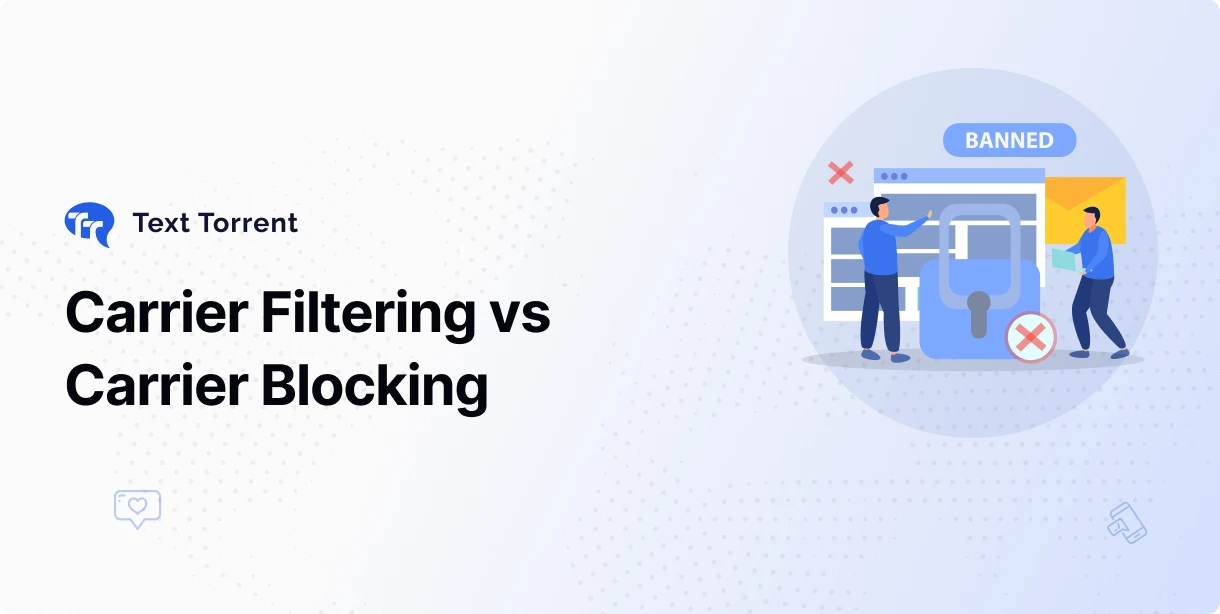
Understanding the difference between carrier filtering and blocking helps teams determine whether declining delivery is an early risk warning or a stronger enforcement action.
Common Mistake
Teams focus on campaign performance while ignoring deliverability trends.
By the time filtering becomes obvious, the underlying problem has often been developing for an extended period.
How Multiple Triggers Compound Together
One trigger rarely causes severe filtering.
Multiple triggers occurring simultaneously are usually far more concerning.
For example:
New number
High volume spike
Promotional content
Weak consent quality
Individually, each factor may be manageable.
Together, they create a significantly higher-risk profile.
This is why filtering investigations should examine the entire messaging program rather than searching for a single cause.
Carrier Filtering Prevention Checklist
Before launching campaigns, verify:
Compliance
Registration information is current
Consent records are documented
Campaign behavior matches approved use cases
Complaint rates remain low
Opt-outs are monitored
Delivery trends remain stable
New numbers are warmed gradually
Volume increases are controlled
Sending schedules remain consistent
Links use trusted domains
Messages remain relevant
Repetitive patterns are minimized
Carrier filtering is rarely triggered by one word, one campaign, or one technical mistake. Modern filtering systems review several signals. Together, these signals decide how much carriers trust a messaging program.
Common triggers include high complaint rates and weak consent. They also include volume spikes and new-number behavior. Other triggers include registration mismatches and reputation issues. Repetitive messages and poor link reputation can also trigger filters. Inconsistent traffic patterns and ignored warning signs are also common triggers.
Organizations that understand these signals gain an operational edge. They can spot risk early and avoid delivery drops. They can also keep stronger carrier trust. This helps them build messaging programs that perform well as they scale.